ABG All Board Games
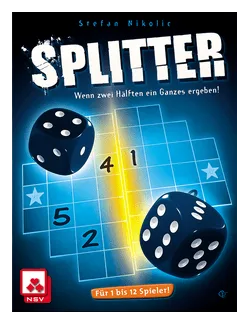
Splitter box art
Rich game profile

Splitter

In Splitter, you must group numbers together to score points — two 2s, three 3s, and so on — but you're placing two numbers at a time, so things won't always work out. Each player has their own score sheet with 44 empty spaces on it, with two different patterns of spaces included...

Players

1-12

Time

?-?

Age

8+

Weight

1

Rating

6.45

Should this hit the table?

Quick read before the metadata.

Splitter has a high level of direct confrontation and strategic depth in confrontation. Players must frequently pay attention to and react to each other's strategies. However, the game does not require much cooperation as players primarily compete against each other.

Teach 2.4

Teaching signal

Replay 4.1

High replayability

Interaction 3.6

Highly interactive

Scaling 4.4

Scales well

Strategy 4.7

Deep strategy

Control 3.5

More strategic control

Table feel

Splitter has a high level of direct confrontation and strategic depth in confrontation. Players must frequently pay attention to and react to each other's strategies. However, the game does not require much cooperation as players primarily compete against each other.

Replay value

The game offers a high degree of variability with different experiences each time it is played. The presence of expansions adds new content and gameplay elements. There is deep strategic depth and room for players to improve their strategy over time. The game scales well with different numbers of players without compromising its appeal or balance. It has a moderate level of easiness to learn, making it accessible to a wide range of players. Overall, the game has a strong replayability score of 8.1.

Luck profile

The final luck score for Splitter is 7, indicating a game that has a balanced mix of luck and strategy. Random elements have a notable but not exclusive impact on the game outcome, and players have substantial ability to mitigate randomness through strategic decisions and planning. The game outcome is primarily determined by player strategy and decisions, with luck playing a minor role.

Overview

What ABG knows about this game

In Splitter, you must group numbers together to score points — two 2s, three 3s, and so on — but you're placing two numbers at a time, so things won't always work out. Each player has their own score sheet with 44 empty spaces on it, with two different patterns of spaces included in the box; each pattern has a dashed line through the middle that splits it into two mirrored halves. On a turn, someone rolls two six-sided dice. Each player then writes the results, e.g. 1 and 4, in empty spaces in the pattern, with each number being in the mirrored space of the other. If, say, you place the 1 in the leftmost space of the top row, then you must place the 4 in the rightmost space of the top row. After 22 dice rolls, everyone's pattern will be filled. Each 1 on its own — that is, with no other 1s orthogonally adjacent — scores 1 point; each set of two 2s that have no other orthogonally adjacent 2s score 2 points; and so on up to a set of six 6s with no other orthogonally adjacent 6s being worth 6 points. A starred space is present on each half of the pattern, and a scored group that contains this starred space has its points doubled. (One pattern has a set of three spaces with hearts, and if you fill all three hearts with the same number, you score 5 points.) Whoever has the highest score wins.
Media

Images and visual references

Images, galleries, and videos are grouped here so the page feels visual before every asset is fully hosted.

Editions

Versions and regional releases

Edition Year Language Publisher / Region
No editions imported yet.

Files and documents

Rules, aids, translations

No files imported yet.

Commerce mapping

Buying signals

No commerce mappings imported yet.

Credits

People and publishers

Linked items

Graph expansion queue

Related games and expansions help build a connected catalog around every title.

No linked items imported yet.