Overview
What ABG knows about this game
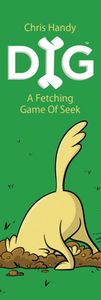
In DIG, each player is a dog that will run throughout the Yard, dig up bones and attempt to return them to the matching colored Dog Bowl with the greatest efficiency. All players will score once, at the end of the game, based on the cumulative value of the Bones that they returned to the matching Dog Bowls. There are 4 Bones in each of the 5 colors in the game. A Bone's value is determined at the end of the game, based on the distance of its corresponding Dog Bowl to the Dog House. The Dog Bowl that is closest to the Dog House will yield a value of 5 for each bone of that color. The Dog Bowl that is second closest to the Dog House will yield a value of 4 for each bone of that color, and so on. The Bowls and Bones will be swapped from the end of the Yard into the place of a recently dug up bone, continuously moving the 5 Bowls to the end of the Yard nearest the Dog House. Each Yard Card has a Scent with 2 colors. The Bone on the opposite side of the Yard Card matches 1 of the colors of the Scent. This will help players determine which color Bone might be dug if that Yard Card is selected for digging. One of the most interesting aspects of DIG is the unique "Leap Frog" Yard replacement mechanism. When a Bone is dug up, the Card that is furthest from the the Dog House is removed and fills the empty spot created by the Dog. This action creates some interesting ways to influence which Bones and Bowls each Dog has close access to, but also makes timing critical for influencing Bone value for scoring. On a player's turn, they may perform three of the following actions in any combination: MOVE: A player may move their Dog a maximum of 4 cards along the Yard Cards, and 1 less for each Bone they hold prior to movement. For example, if a player holds 2 Bone cards, they may move their Dog up to 2 Cards, moving below or above the Yard cards. A player may move their Dog in any direction. There is a movement legend on the bottom half of the Dog House for easy reference. DIG: A player may dig up a bone and place the Bone card in their hand. Bones that are in the hand are kept secret until they are dropped off and placed in front of the player. The empty space created from the Yard Card removal is filled with the last Card at the edge of Yard. A player may have no more than 3 Bones in their hand at any time. DROP: Drop a Bone into a Dog Bowl and place the Bone card from your hand to the playing area in front of yourself, face up with the Bone visible to all players. A Dog must be AT the Bowl of the corresponding color in order to drop off any Bones of that color. Game End and Scoring: When Bowls are the only remaining Cards in the Yard (next to the Dog House), the game ends immediately and players total their scores. Any Bones still in a player's hand are removed from the game and do not count for scoring. Number 12 in the Pack O Game series.