Overview
At a glance
Is this game right for my group?
ABG editorial scores on a 1–5 scale.
Harder to teach
High replayability
Highly interactive
Scales well
Deep strategy
How it plays
How does it play?
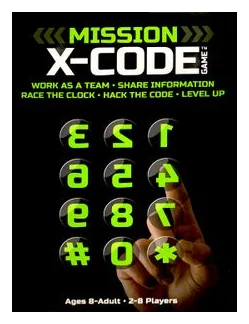
In X-Code, all players play simultaneously to cooperatively crack an encrypted code against time. The game board is constructed like a number field.
Core mechanisms
Key systems that shape the decisions players make.
Hand Management
Time and sequence a limited hand of cards to preserve future options.
Set Collection
Gather related items that become more valuable when scored together.
Cooperative Game
Players coordinate their actions toward a shared objective and win or lose together.
Real-Time
Players act under continuous time pressure rather than taking normal turns.
Read the full game description
In X-Code, all players play simultaneously to cooperatively crack an encrypted code against time. The game board is constructed like a number field. The goal is to place a set of three equal cards on each square, including # and *. At the beginning, each player starts with three cards. As soon as the hourglass is turned over, gameplay becomes fast-paced: Players can draw or discard cards. In order to win the game, however, an exchange of cards with their neighbors is indispensable. The cards may not be passed on freely, however. Each card shows an arrow that indicates whether the right or left neighbor can be traded with and they must be ready to return a suitable card. Jokers allow you to replace missing cards. Once a player has a set of three equal cards in hand, they can place it on the appropriate space, either cracking part of the code or earning extra time. Storing time cards allows you to turn the hourglass over and earn valuable seconds. If the code can be cracked so that all fields are filled with the appropriate cards, the players have won together and can compete in another level.