Overview
At a glance
Is this game right for my group?
ABG editorial scores on a 1–5 scale.
Harder to teach
High replayability
Highly interactive
Scales well
Deep strategy
How it plays
How does it play?
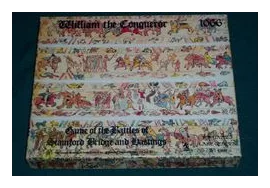
William the Conqueror - 1066 is a two or three player tactical wargame which recreates the Battles of Stamford Bridge and Senlac Hill (more commonly known as the Battle of Hastings), the most decisive battles ever fought on English soil.
Core mechanisms
Key systems that shape the decisions players make.
Dice Rolling
Roll dice to introduce uncertainty into actions, production, movement, or resolution.
Simultaneous Action Selection
Choose actions secretly or concurrently before revealing them together.
Simulation
Model a real or imagined system through detailed cause-and-effect rules.
Hexagon Grid
Use a hexagonal map where each space connects evenly in six directions.
Read the full game description
William the Conqueror - 1066 is a two or three player tactical wargame which recreates the Battles of Stamford Bridge and Senlac Hill (more commonly known as the Battle of Hastings), the most decisive battles ever fought on English soil. The results of these battles profoundly changed the course of English history and language. At Stamford Bridge, the Viking invasion of England was repulsed by the Anglo-Saxon army, while three weeks later, at Senlac Hill, the Norman invaders successfully defeated the Anglo-Saxon army and were able to conquer the whole of England. The outcome of the Battle of Senlac Hill was a direct result of the Battle of Stamford Bridge. In a campaign game, players play the Battle of Stamford Bridge first. Then the Battle of Senlac Hill is played with an order of battle determined by the outcome of the Battle of Stamford Bridge. Either game may be played independently of the other. 1066 uses a revolutionary innovation in wargaming entitled the MOVEMENT RESOLUTION SYSTEM. There is no die to throw nor any card to choose. The result of an attack depends entirely upon how intelligently you move, not the luck of the die. The MOVEMENT RESOLUTION SYSTEM consists of the attacker moving adjacent to an enemy unit, then both players moving one hex simultaneously. The result of this move determines the result of the attack.