Overview
At a glance
Is this game right for my group?
ABG editorial scores on a 1–5 scale.
Harder to teach
High replayability
Highly interactive
Scales well
Deep strategy
How it plays
How does it play?
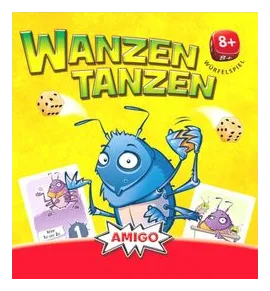
In Wanzen Tanzen ("Dancing Bugs") you will not dance and the only bugs you'll encounter are made of cardboard. What you will find in the box is a dice-and-card game in which you're challenged to compete multiple tasks on a card in order to claim it for points.
Core mechanisms
Key systems that shape the decisions players make.
Read the full game description
In Wanzen Tanzen ("Dancing Bugs") you will not dance and the only bugs you'll encounter are made of cardboard. What you will find in the box is a dice-and-card game in which you're challenged to compete multiple tasks on a card in order to claim it for points. At the start of the game, shuffle the 28 task cards, then place fifteen of them face-down and remove the rest from the game. Place the five penalty cards (worth -1 to -5 points) in order with the -5 on the bottom. Give the starting player the five dice, then reveal the top task card. On a turn, the active player starts by rolling all the dice, then she has two choices: Set aside at least one die, then roll any remaining dice. Take one baby bug token and reroll all dice just rolled. After each roll, a player has these two options. She continues until either she sets aside all five dice or takes a fifth baby bug. (More on that below.) If the player has set aside all the dice and has completed one (or more) of the tasks on the card, she covers one task with a marker. If no tasks remain uncovered, she claims the task card, which is worth positive points, then the next player reveals the next task card and takes his turn. If at least one task remains uncovered, the player can either take another turn immediately or pass the dice to the next player. If the player has set aside all the dice without completing a task, she takes two baby bug tokens, and the next player takes a turn. As soon as a player has five or more baby bugs, that player claims the top penalty card and all players return all baby bugs to the supply. The game ends as soon as the last task card or the last penalty card has been claimed. Players sum their points, and the player with the highest score wins.