Overview
At a glance
Is this game right for my group?
ABG editorial scores on a 1–5 scale.
Harder to teach
High replayability
Highly interactive
Scales well
Deep strategy
How it plays
How does it play?
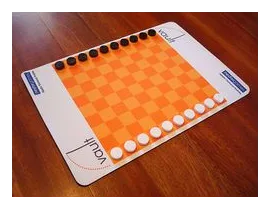
INTRODUCTION Vault is an abstract game in which each player tries to reach the opponent’s back rank. Vault is named after pole vaulting, which is a track and field event in which a person uses a long, flexible pole as an aid to jump over a bar.
Core mechanisms
Key systems that shape the decisions players make.
Read the full game description
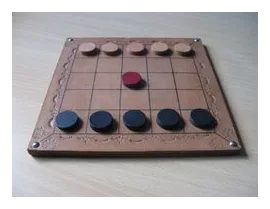
INTRODUCTION Vault is an abstract game in which each player tries to reach the opponent’s back rank. Vault is named after pole vaulting, which is a track and field event in which a person uses a long, flexible pole as an aid to jump over a bar. Vault is a derivative of Onager, by the same designer and uses a variation of its jumping mechanism (also present in Billabong, for example) that allows multiple directions to be used. It’s like vector movement but without acceleration. Unlike Onager, Vault only works well on a square grid, as jumping directions are difficult to visualize in a hexagonal grid. MATERIAL - A square grid with an even number of cells (recommended 10x10). Preferably checkered* for clarity, but this is not mandatory. - As many white and black pawns as the number of cells per side. SETUP Each player has an allocated colour (Black or White). Fill your nearest row with pawns of your colour (one per cell). HOW TO PLAY White starts. Players alternate turns during the game until the victory condition is reached. On your turn, either walk or jump with one of your pawns. Walk Move one of your pieces to an adjacent empty space as a King in Chess. Jump In order to jump, choose 2 friendly pieces. One of the pieces then jumps over the other piece in the direction defined by both pawns, landing on a space beyond that is at a distance equal to the distance between the two friendly pieces before the jump was made (like a mirror). Notice that jumping is not restricted to orthogonal or diagonal directions. The landing space must be either empty or occupied by an enemy piece, which is then captured and removed from the game. A piece cannot land on a friendly piece. Pieces cannot land outside the board. Notice that the spaces between the jumping pawn and the landing space don’t need to be empty. Also, captures can only be made by jumping. GAME END If at the start of your turn you have at least one piece on your opponent's back rank then you have won. If the above condition is not reached and you can’t make a legal movement at the start of your turn, you lose. This rarely happens. Players may agree on a draw at any moment during the game. NOTES FROM THE DESIGNER This is intended to be the simplest game that uses this jumping mechanism. I’ve decided not to use Onager’s stacking mechanism (in order to make is simpler for turn based online play and also playable with non-stacking pieces) or the multiple jump (as it would be almost impossible to think ahead). As a variant, you can use the stacking mechanism of Onager. (*) On a checkered board, the jumping piece always lands in a space of the same colour as the starting one.