Table feel
Trumpet has a high level of direct confrontation and strategic depth in confrontation. Players need to frequently pay attention to and react to each other's strategies. However, there is less emphasis on cooperation in the game.
Teaching signal
High replayability
Highly interactive
Scales well
Deep strategy
More strategic control
Trumpet has a high level of direct confrontation and strategic depth in confrontation. Players need to frequently pay attention to and react to each other's strategies. However, there is less emphasis on cooperation in the game.
Trumpet offers a high level of variability with its gameboard, multiple paths to victory, and variable setups. The expansions available add new content and gameplay elements, enhancing the replay value. The game provides deep strategic possibilities and allows players to improve their tactics and strategies over time. The player interaction score is moderate, and the game scales well with different numbers of players. While it may take some time to learn, the easiness to learn score is relatively low. Overall, Trumpet has a strong replayability score of 7.7.
Trumpet has a moderate level of luck influence. While random elements have minimal impact on the game outcome, players have substantial ability to mitigate randomness through strategic decisions and planning. The game outcome is primarily determined by player strategy and decisions, with luck playing a minor role.
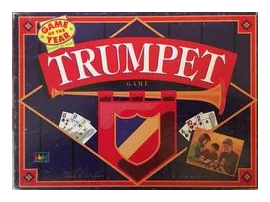
In this light, short trick-taking game, there are six suits with cards numbered one through eleven, plus 3 wild cards. If you take a trick, you advance your scoring token, however each scoring space can only be occupied by one person, jumping the piece[s] immediately ahead of you. In addition, there are certain spaces which allow that player to set one of the suits as trump. Eventually all the suits are established as some form of trump, however each of them is ranked top to bottom. Once one of the players enters the home stretch of the scoring track, players can chose to move the leaders back a space instead of moving themselves up, but the winner is the player who crosses the finish line first. Won Games Magazine Game of the Year award in 1991.
| Edition | Year | Language | Publisher / Region |
|---|---|---|---|
| No editions imported yet. | |||
No files imported yet.
No commerce mappings imported yet.