Table feel
Tricky Bid has a high level of direct confrontation and strategic depth in confrontation. Players need to pay frequent attention to other players' actions. However, there is less emphasis on cooperation in the game.
Players
2-4
Time
?-?
Age
12+
Weight
1.58
Rating
6.16
Teaching signal
High replayability
Highly interactive
Scales well
Deep strategy
Luck-sensitive
Tricky Bid has a high level of direct confrontation and strategic depth in confrontation. Players need to pay frequent attention to other players' actions. However, there is less emphasis on cooperation in the game.
Tricky Bid has a high variability gameboard, offering different experiences each time it is played. The presence of expansions adds new content and gameplay elements, enhancing replay value. The game also provides deep strategic possibilities and room for improvement over time. The player interaction score is average, and the game scales well with different numbers of players. While the easiness to learn score is moderate, it still allows for a satisfying depth of gameplay. Overall, Tricky Bid has a solid replayability score of 7.6.
Tricky Bid has a moderate influence of luck. Random elements have a notable but not exclusive impact on the game outcome. Players have substantial ability to mitigate randomness through strategic decisions and planning. The game outcome is primarily determined by player strategy and decisions, with luck playing a minor role.
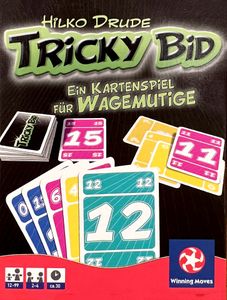
Tricky Bid is a trick-taking game in which half the cards in hand will be used for bidding and the other half for tricks. Before each trick, each player takes turns placing a card face-up on the table, which represents his bid for that trick. The player who leads then plays a card, and each player follows suit if possible, with the highest card on suit (or the highest trump, if one was played) winning the trick. The cards in the trick are thrown away, however, and the winner of the trick keeps only his bid card and all other bid cards of the same color. Since bidding is done in turn order, all but the starting player can decide to join in on a bid (by playing a card of the same color as the lead player, thereby raising the stakes) or start a bid in a new color. Players score points based on the bid cards they collect, and the player with the most points after each person has dealt once wins the game.
| Edition | Year | Language | Publisher / Region |
|---|---|---|---|
| No editions imported yet. | |||
No files imported yet.
No commerce mappings imported yet.
No linked items imported yet.