Table feel
Takla has a high level of direct confrontation and strategic depth, with frequent interaction among players. However, it does not emphasize cooperation as much.
Players
2-4
Time
10-20
Age
7+
Weight
?
Rating
6.50
Teaching signal
High replayability
Highly interactive
Scales well
Deep strategy
More strategic control
Takla has a high level of direct confrontation and strategic depth, with frequent interaction among players. However, it does not emphasize cooperation as much.
Takla offers a high level of variability with its gameboard, multiple paths to victory, and variable setups. The presence of expansions adds further content and gameplay elements. The game provides deep strategic possibilities and room for improvement over time. It scales well with different numbers of players and offers a consistent and engaging experience. While it may not be the easiest game to learn, it still offers a good balance between easiness and depth. Overall, Takla has a strong replayability score of 8.1 out of 10.
Takla has a moderate level of luck involved in the game. Random elements have a notable but not exclusive impact on the game outcome. However, players have substantial ability to mitigate randomness through strategic decisions and planning. The game outcome is primarily determined by player strategy and decisions, with luck playing a minor role. Overall, Takla strikes a good balance between luck and strategy, making it an engaging and challenging board game.
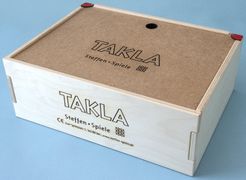
The goal of Takla sounds simple: Place wooden blocks to create a structure that touches the red ball in the center of the playing area. The challenge, though, comes from where you start building and where the ball is located. The ball is on a column, and you can place it as high or as low as you want, with more height equalling a greater challenge. Each of the 2-4 players starts building at a certain mark away from the column, although you could handicap some players by starting them further back. You need to stack the wooden blocks to create a floating one-ended bridge, a bridge that reaches out toward the ball and ideally doesn't collapse under its own weight or unbalanced nature. You can play a real-time game in which whoever touches the ball first wins, a pauper's game in which whoever uses the fewest pieces wins, or a turn-based game in which players place blocks one by one.
| Edition | Year | Language | Publisher / Region |
|---|---|---|---|
| No editions imported yet. | |||
No files imported yet.
No commerce mappings imported yet.
No linked items imported yet.