Table feel
Split Second has a high level of direct confrontation and strategic depth in confrontation. Players must frequently pay attention to and react to others' strategies and turns. However, the game does not emphasize cooperation as much.
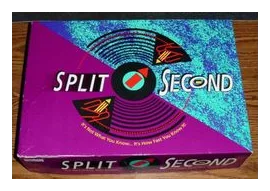
A question is read, and each player writes the answer down on a paddle; when released, the paddle will flip up into the middle, thanks to a clever rubber-band mechanism. The player who first turns in the correct answer wins the point. If no one turns in the correct answer, then (...
Players
3-6
Time
?-?
Age
10+
Weight
1
Rating
6.22
Should this hit the table?
Split Second has a high level of direct confrontation and strategic depth in confrontation. Players must frequently pay attention to and react to others' strategies and turns. However, the game does not emphasize cooperation as much.
Teaching signal
High replayability
Highly interactive
Scales well
Deep strategy
Luck-sensitive
Split Second has a high level of direct confrontation and strategic depth in confrontation. Players must frequently pay attention to and react to others' strategies and turns. However, the game does not emphasize cooperation as much.
Split Second offers a high level of variability with its gameboard, allowing for different experiences each time it is played. The presence of expansions adds to the replay value, providing new content and gameplay elements. The game also offers deep strategic possibilities, allowing players to improve their strategies over time. The player interaction score is average, and the game scales well with different numbers of players. While it may not be the easiest game to learn, it offers enough depth to keep players engaged. Overall, Split Second has a strong replayability score of 8.03.
Split Second has a moderate influence of luck. The game outcome is not predominantly determined by random elements, but they still have a notable impact. Players have substantial ability to mitigate randomness through strategic decisions and planning. The game relies on a balanced mix of luck and strategy, with neither element dominating the outcome.
Overview
A question is read, and each player writes the answer down on a paddle; when released, the paddle will flip up into the middle, thanks to a clever rubber-band mechanism. The player who first turns in the correct answer wins the point. If no one turns in the correct answer, then (for number questions) the closest answer wins the point. Each answer is no longer than four characters. Questions range from very easy ("I could have had a V-_!") to ridiculously difficult ("How many teeth does a sloth have?"), and make for an amusing challenge. Adding spice are the personal questions ("How many times have I lost a job?"), where you have to guess what the reader answered.
Media
Images, galleries, and videos are grouped here so the page feels visual before every asset is fully hosted.
No media imported yet.
Editions
| Edition | Year | Language | Publisher / Region |
|---|---|---|---|
| No editions imported yet. | |||
Files and documents
No files imported yet.
Commerce mapping
Credits
Linked items
Related games and expansions help build a connected catalog around every title.
No linked items imported yet.