Table feel
Moderate level of direct and strategic confrontation with high interaction frequency, but low emphasis on cooperation.
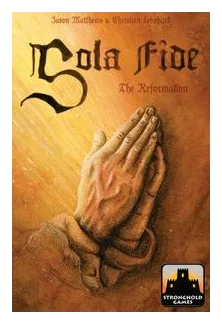
Despite earlier attempts, Martin Luther started the Reformation in 1517 with his "Ninety-Five Theses". Luther criticized the selling of indulgences and stated that the Catholic doctrine of the merits of the saints had no foundation in the gospel. The "Protestants" soon incorporat...
Players
2
Time
?-?
Age
12+
Weight
2
Rating
6.41
Should this hit the table?
Moderate level of direct and strategic confrontation with high interaction frequency, but low emphasis on cooperation.
Teaching signal
High replayability
Highly interactive
Scales well
Deep strategy
More strategic control
Moderate level of direct and strategic confrontation with high interaction frequency, but low emphasis on cooperation.
sola fide: the reformation has a high replayability score due to its high variability gameboard, availability of expansions, deep strategic possibilities, and good scalability. The game offers different experiences each time it is played, with multiple paths to victory and variable setups. The expansions add new content and gameplay elements, enhancing the replay value. There is room for players to improve their strategy over time, discovering new tactics and strategies. The game adapts well to different player counts without compromising its appeal or balance. While it may not be the easiest game to learn, it offers a good balance between easiness and depth. Overall, sola fide: the reformation provides a fresh and engaging experience with high replayability potential.
Sola Fide: The Reformation has a moderate level of luck involved in gameplay. Random elements such as card draws and dice rolls have a notable but not exclusive impact on the game outcome. However, players have substantial ability to mitigate the effects of luck through strategic decisions and planning. The game outcome is primarily determined by player strategy and decisions, with luck playing a minor role. Overall, Sola Fide: The Reformation strikes a good balance between luck and strategy.
Overview
Despite earlier attempts, Martin Luther started the Reformation in 1517 with his "Ninety-Five Theses". Luther criticized the selling of indulgences and stated that the Catholic doctrine of the merits of the saints had no foundation in the gospel. The "Protestants" soon incorporated doctrinal changes such as Sola Scriptura (Scripture alone) and Sola Fide (faith alone). These changes turned out to be not only theological, but also influential in the Reformation in other ways: the rise of nationalism, the Western Schism that eroded people's faith in the Papacy, the perceived corruption of the Roman Curia, the impact of humanism, and the new learning of the Renaissance that questioned much of traditional thought. The Roman Catholic church responded with a counter-reformation initiated by the Council of Trent. In the two-player game Sola Fide: The Reformation, by the renowned design team of Jason Mathews and Christian Leonhard, players attempt to install Reformation in the Holy Roman Empire or try to prevent it, battling the Holy Roman Empire's Imperial Circles.
Media
Images, galleries, and videos are grouped here so the page feels visual before every asset is fully hosted.
Editions
| Edition | Year | Language | Publisher / Region |
|---|---|---|---|
| No editions imported yet. | |||
Files and documents
No files imported yet.
Commerce mapping
Credits
Linked items
Related games and expansions help build a connected catalog around every title.
No linked items imported yet.