Overview
At a glance
Is this game right for my group?
ABG editorial scores on a 1–5 scale.
Harder to teach
High replayability
Highly interactive
Scales well
Deep strategy
How it plays
How does it play?
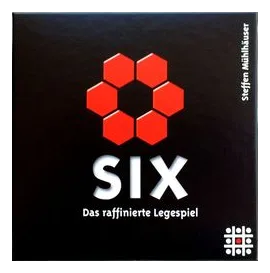
Six is a deceptively simple-looking abstract strategy game in which two (or four) players take turns placing their colored hexagonal tiles while trying to create one of the three "winning shapes" – triangle, hexagon or line – out of six of their tiles.
Core mechanisms
Key systems that shape the decisions players make.
Pattern Building
Place elements to create arrangements that satisfy scoring or action patterns.
Tile Placement
Place tiles to build a shared or personal spatial arrangement.
Team-Based Game
Players compete in fixed teams and coordinate toward a shared team result.
Hexagon Grid
Use a hexagonal map where each space connects evenly in six directions.
Read the full game description
Six is a deceptively simple-looking abstract strategy game in which two (or four) players take turns placing their colored hexagonal tiles while trying to create one of the three "winning shapes" – triangle, hexagon or line – out of six of their tiles. If all tiles have been placed from players' hands without someone winning, players then take turns picking up a previously placed tile and moving it to a new position. With the advanced rules, players are allowed to move a tile that will separate all the tiles into two or more groups; by doing this, some pieces are removed from the game, and this provides an alternate way to win by reducing the opponent to five or fewer pieces (as the opponent cannot possibly form a winning shape).