Overview
At a glance
Is this game right for my group?
ABG editorial scores on a 1–5 scale.
Harder to teach
High replayability
Highly interactive
Scales well
Deep strategy
How it plays
How does it play?
Uncertainty didn't kill the cat, but that doesn't mean it's not dead. Dr.
Core mechanisms
Key systems that shape the decisions players make.
Read the full game description
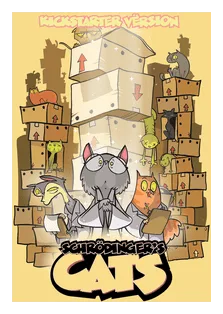
Uncertainty didn't kill the cat, but that doesn't mean it's not dead. Dr. Erwin Schrödinger and Werner Heisenberg taught us that. We've all heard about the cats in boxes experiment, and maybe we're even curious about the results — but attempting such an experiment would be INSANE in real life! Now you can try your hand at challenging the uncertainty principle without risking the lives of innocent kittens or exposure to radioactive particles! Awww! In Schrödinger's Cats, players run experiments, form hypotheses, and try to one-up each other's research. Players take on the role of a cat physicist such as Albert Felinestein, Sally Prride, or Neil deGrasse Tabby. Using their special ability to help prove their hypothesis — or at least debunk someone else's — each cat physicist tries to determine the minimum number of alive cats, dead cats, or empty boxes across all the boxes in Schrödinger's lab. In more detail, each player starts with six cards in hand, along with a physicist card. The first player asserts how many identical cards — whether live cat, dead cat, or empty box — are present among all the cards in play. The next player can increase the number of this claim or call. Each player can use their ability once during the round. When a player does call, whoever was right — whether about the claim or about doubting that claim — stays in the game, while the other player is eliminated. Each remaining player gets a new hand with one fewer card, and you keep playing rounds until only one player remains.