Table feel
Samara has a high level of direct confrontation and strategic depth in confrontation. Players need to frequently pay attention to and react to others' strategies and turns. However, there is less emphasis on cooperation in the game.
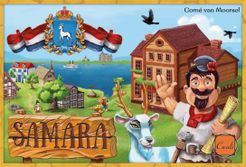
Travel back through history to a settlement called Samara, where you lead a group of builders. At the start of the game, they can build only a sandcastle, cave or huts. For more complex buildings, you first invest time in skills, strength, or new workers. Building special project...
Players
2-5
Time
25-50
Age
10+
Weight
2.12
Rating
6.23
Should this hit the table?
Samara has a high level of direct confrontation and strategic depth in confrontation. Players need to frequently pay attention to and react to others' strategies and turns. However, there is less emphasis on cooperation in the game.
Teaching signal
High replayability
Highly interactive
Scales well
Deep strategy
Luck-sensitive
Samara has a high level of direct confrontation and strategic depth in confrontation. Players need to frequently pay attention to and react to others' strategies and turns. However, there is less emphasis on cooperation in the game.
Samara has a high variability gameboard, with different experiences each time it is played. The availability of expansions adds to the replay value. The strategic depth allows players to improve their strategies over time. The game scales well with different player counts and offers a moderate level of easiness to learn. Overall, Samara has a strong replayability score of 7.9.
Samara has a moderate influence of luck. Random elements have a notable but not exclusive impact on the game outcome. Players have substantial ability to mitigate randomness through strategic decisions and planning. The game outcome is primarily determined by player strategy and decisions, with luck playing a minor role.
Overview
Travel back through history to a settlement called Samara, where you lead a group of builders. At the start of the game, they can build only a sandcastle, cave or huts. For more complex buildings, you first invest time in skills, strength, or new workers. Building special projects gives you benefits or hurts all your rivals. In the end you want to have the most prestigious buildings. The worker timetrack is the key mechanism. Each of your choices costs a number of your workers a number of months. Your workers can spend time on: Improving skills to build with wood (saw tool), stone (trowel tool) and glass (blowing tool). Building houses or special projects. Getting a new worker or exercising to become a stronger worker. Going on vacation. The spaces on the game board determine how many workers (1-4 on the left board axis) are occupied how many months (1-9 on the bottom board axis). Players plan to let their workers spend time effectively, choosing when to invest and when to build for prestige. The prestige points determine who is the best foreman of Samara.
Media
Images, galleries, and videos are grouped here so the page feels visual before every asset is fully hosted.
Editions
| Edition | Year | Language | Publisher / Region |
|---|---|---|---|
| No editions imported yet. | |||
Files and documents
No files imported yet.
Commerce mapping
Credits
Linked items
Related games and expansions help build a connected catalog around every title.
No linked items imported yet.