Overview
At a glance
Is this game right for my group?
ABG editorial scores on a 1–5 scale.
Harder to teach
High replayability
Low interaction
Player-count sensitive
Light strategy
Luck-sensitive
How it plays
How does it play?
Cross Terrinoth by terrain dice, overcome escalating adventures, and turn hard-won skills, allies, and gear toward the final confrontation.
Core mechanisms
Key systems that shape the decisions players make.
Dice Rolling
Roll dice to introduce uncertainty into actions, production, movement, or resolution.
Role Playing
Make decisions or communicate from the perspective of an assigned character.
Variable Player Powers
Each player has different abilities, restrictions, or strategic advantages.
Open Drafting
Select cards or items from a shared face-up display.
Area Movement
Move pieces between connected regions rather than along individual spaces.
Hexagon Grid
Use a hexagonal map where each space connects evenly in six directions.
Read the full game description
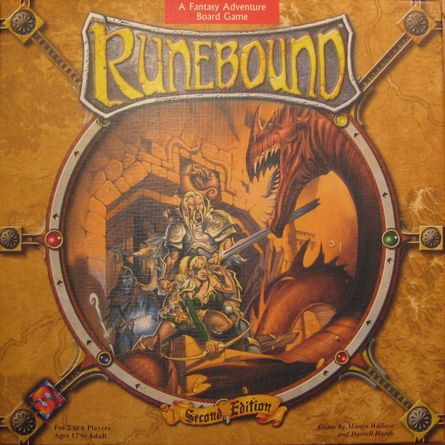
Runebound: Second Edition sends two to six heroes across the realm of Terrinoth on an open-ended fantasy adventure. Movement is determined by terrain dice, making the route between towns and challenge gems a tactical choice rather than a fixed count of spaces. Drawing an adventure launches a test, encounter, or enemy battle, with green, yellow, blue, and red decks creating a clear ladder of danger. Combat unfolds through ranged, melee, and magic phases; defeated foes award gold and experience that buy equipment, recruit allies, and improve a hero’s attributes. Players largely pursue their own journeys on the shared map, but timing matters because rivals can clear desired challenges, occupy useful locations, or reach the endgame first. The standard scenario culminates in a race to find and defeat High Lord Margath, while expansion decks and alternate adventures can reshape the world. It is a long-form, dice-driven character progression game with generous room for exploration.