ABG All Board Games
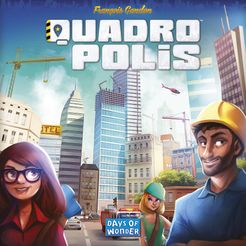
Quadropolis box art
Rich game profile

Quadropolis

Each player builds their own metropolis in Quadropolis (first announced as City Mania), but they're competing with one another for the shops, parks, public services and other structures to be placed in them. The game lasts four rounds, and in each round players first lay out tile...

Players

2-4

Time

30-60

Age

8+

Weight

2.2

Rating

7.23

Should this hit the table?

Quick read before the metadata.

Quadropolis has a moderate level of direct confrontation and strategic depth. Players need to be aware of and react to each other's strategies frequently. While there is some cooperation involved, it is not a major focus of the game. Overall, Quadropolis has a good level of player interaction.

Teach 2.3

Teaching signal

Replay 4.1

High replayability

Interaction 3.8

Highly interactive

Scaling 4.0

Scales well

Strategy 4.5

Deep strategy

Control 3.5

More strategic control

Table feel

Quadropolis has a moderate level of direct confrontation and strategic depth. Players need to be aware of and react to each other's strategies frequently. While there is some cooperation involved, it is not a major focus of the game. Overall, Quadropolis has a good level of player interaction.

Replay value

Quadropolis offers a high level of variability with its gameboard, allowing for different experiences each time it is played. The presence of expansions adds to the replay value, providing new content and gameplay elements. The game also offers deep strategic possibilities, allowing players to improve their strategy over time. The player interaction score is moderate, and the game scales well with different numbers of players. While it may take some time to learn, the game offers a good balance between easiness and depth. Overall, Quadropolis has a strong replayability score of 8.15.

Luck profile

Quadropolis has a moderate level of luck. While random elements like card draws and tile placements can have an impact on the game outcome, players have a significant ability to mitigate luck through strategic decisions and planning. The game relies more on player strategy and decisions, with luck playing a minor role.

Overview

What ABG knows about this game

Each player builds their own metropolis in Quadropolis (first announced as City Mania), but they're competing with one another for the shops, parks, public services and other structures to be placed in them. The game lasts four rounds, and in each round players first lay out tiles for the appropriate round at random on a 5x5 grid. Each player has four architects numbered 1-4 and on a turn, a player places an architect next to a row or column in the grid, claims the tile that's as far in as the number of the architect placed (e.g., the fourth tile in for architect #4), places that tile in the appropriately numbered row or column on the player's 4x4 city board, then claims any resources associated with the tile (inhabitants or energy). When a player takes a tile, a figure is placed in this now-empty space and the next player cannot place an architect in the same row or column where this tile was located. In addition, you can't place one architect on top of another, so each placement cuts off play options for you and everyone else later in the round. After all players have placed all four architects, the round ends, all remaining tiles are removed, and the tiles for the next round laid out. After four rounds, the game ends. Players can move the inhabitants and energy among their tiles at any point during the game to see how to maximize their score. At game end, they then score for each of the six types of buildings depending on how well they build their city — as long as they have activated the buildings with inhabitants or energy as required: Residential buildings score depending on their height Shops score depending on how many customers they have Public services score depending on the number of districts in your city that have them Parks score depending on the number of residential buildings next to them Harbors score based on the longest row or column of activated harbors in the city Factories score based on the number of adjacent shops and harbors Some buildings are worth victory points (VPs) on their own, and once players sum these values with what they've scored for each type of building in their city, whoever has the highest score wins.
Media

Images and visual references

Images, galleries, and videos are grouped here so the page feels visual before every asset is fully hosted.

Editions

Versions and regional releases

Edition Year Language Publisher / Region
No editions imported yet.

Files and documents

Rules, aids, translations

No files imported yet.

Credits

People and publishers

Designers

1
François Gandon

Artists

2
Cyrille Daujean Sabrina Miramon

Publishers

1
Days of Wonder

Linked items

Graph expansion queue

Related games and expansions help build a connected catalog around every title.

No linked items imported yet.