Overview
At a glance
Is this game right for my group?
ABG editorial scores on a 1–5 scale.
Harder to teach
High replayability
Highly interactive
Scales well
Deep strategy
How it plays
How does it play?
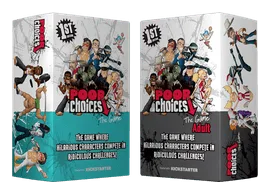
Setup Place all four decks of cards face down in the middle of the table. Deal five Character Cards and five Trait Cards to each player, and keep the remaining decks of cards in the middle of the table.
Core mechanisms
Key systems that shape the decisions players make.
Betting and Bluffing
Risk resources on uncertain outcomes while disguising intentions or information.
Role Playing
Make decisions or communicate from the perspective of an assigned character.
Acting
Communicate information by performing without directly stating the answer.
Rock-Paper-Scissors
Resolve choices through a circular set of strengths and weaknesses.
Storytelling
Create or extend a narrative in response to prompts or game events.
Read the full game description
Setup Place all four decks of cards face down in the middle of the table. Deal five Character Cards and five Trait Cards to each player, and keep the remaining decks of cards in the middle of the table. The person wearing the ugliest shirt is Player One for the first round. If everyone is wearing the exact same shirt or if everyone is shirtless, the shortest person is Player One for the first round. Gameplay The round begins when Player One draws an Adventure Card and reads it out loud. Each adventure needs a character, and it’s the job of the other players to provide the best one. The other players choose a Character Card from their hand that’s best equipped for that particular adventure, and place it face down on the table in front of them. Then players get to attack one of their opponents. The same players choose a Trait Card from their hand to sabotage their opponent’s character, and pass it face down to the player on their right. Players should not look at the trait that’s passed to them. At this point, each player (except Player One) should have the character that they chose along with the trait that their opponent gave to them. Player One gathers all of the character and trait combinations and reads them out loud. Then, Player One decides which character is the best and worst choice for that particular adventure. Scoring Players are rewarded for making poor choices — not good ones. The player who played the trait of the worst choice earns a point and becomes Player One for the next round. The player who played the trait of the best choice must draw a Humiliation Card and do whatever it says to do. If the losing player has one or more points, he or she also has the option to avoid the humiliation at the cost of one point. Finally, each player (except Player One) draws a new Character Card and a new Trait Card so they have five of each for the next round. The next round begins when the winner draws a new Adventure Card. Winning The first player to earn five points wins. If you run out of cards, you can reshuffle them and continue playing. If you run out of time, the player who accumulates the most points wins. If there’s a tie after all of this, it’s obvious that this group can’t even make poor choices the right way — so nobody deserves to win.