Table feel
Plingpong has a high level of direct confrontation and strategic depth in confrontation. Players need to frequently interact and react to each other's strategies and turns. However, there is less emphasis on cooperation in the game.
Players
2-4
Time
20-30
Age
8+
Weight
1
Rating
6.46
Teaching signal
High replayability
Highly interactive
Scales well
Deep strategy
More strategic control
Plingpong has a high level of direct confrontation and strategic depth in confrontation. Players need to frequently interact and react to each other's strategies and turns. However, there is less emphasis on cooperation in the game.
plingpong has a high variability gameboard, with different experiences each time it is played. The expansions available add new content and gameplay elements, enhancing the replay value. The game offers deep strategic possibilities and room for players to improve their tactics and strategies. The player interaction score is average. The game scales well with different numbers of players without compromising its appeal or balance. It is moderately easy to learn, providing a good balance between depth and accessibility. Overall, plingpong has a strong replayability score of 7.8.
Plingpong has a moderate influence of luck. Random elements have a notable but not exclusive impact on the game outcome. While luck plays a significant role, players have substantial ability to mitigate randomness through strategic decisions and planning. The game outcome is primarily determined by player strategy and decisions, with luck playing a minor role.
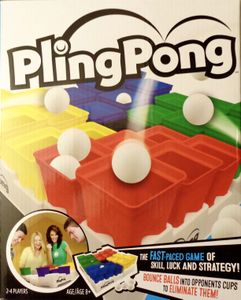
PlingPong is a dexterity game. The game comes with four (4) interlocking trays to create a single game board, which holds a black cup in the middle and four (4) sets of six (6) colored cups on each tray. Each player get a color (or two (2) colors if playing with two (2) players). Play is played on any table you can bounce a ping pong ball on. With the board setup diagonally, players shoot over their color, to hit the other player’s cups. In each round players shoot twice, then score the round; empty cups stay on the board, cups with an Odd number of balls come off and cups with an Even number of balls stay on. The goal is to bounce your shots into the opponent’s cups, while avoiding the black cup in the middle. If the black cup has an odd numbers of balls, each player who placed a ball in the cup lose one of their cups, and the other players gain a cup. If there is an even number of balls in the black cup, the effect of the black cup is cancelled. Even if you have no cups left, you are still in the game, because you will get one back when someone makes a black cup shot. The last player with cups on the board wins.
| Edition | Year | Language | Publisher / Region |
|---|---|---|---|
| No editions imported yet. | |||
No files imported yet.
No linked items imported yet.