Table feel
Pharaoh Code has a high level of direct confrontation and strategic depth in confrontation. Players must frequently pay attention to and react to others' strategies and turns. However, there is less emphasis on cooperation in the game.
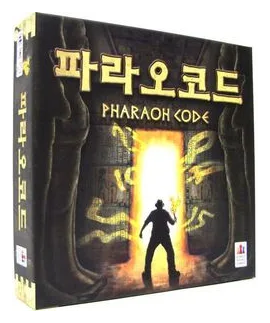
In Pharaoh Code, you're trying to claim as many scarabs as you can by solving the aforementioned codes. To set up the game, you divide the number tiles into four piles based on the number of scarabs on them, with more scarabs typically signifying larger numbers. To create the num...
Players
2-5
Time
?-?
Age
10+
Weight
1.4
Rating
6.03
Should this hit the table?
Pharaoh Code has a high level of direct confrontation and strategic depth in confrontation. Players must frequently pay attention to and react to others' strategies and turns. However, there is less emphasis on cooperation in the game.
Teaching signal
High replayability
Highly interactive
Scales well
Deep strategy
More strategic control
Pharaoh Code has a high level of direct confrontation and strategic depth in confrontation. Players must frequently pay attention to and react to others' strategies and turns. However, there is less emphasis on cooperation in the game.
Pharaoh Code offers a high level of variability in gameplay, with multiple paths to victory and random elements. The presence of expansions adds new content and enhances the replay value. The game provides deep strategic possibilities and allows players to improve their tactics over time. It adapts well to different player counts without compromising its appeal or balance. While it may take some time to learn, the depth it offers makes it worth the effort. Overall, Pharaoh Code has a strong replayability score of 7.85.
Pharaoh Code has a moderate level of luck involved in the game. Random elements have a notable but not exclusive impact on the game outcome. However, players have substantial ability to mitigate randomness through strategic decisions and planning. The game outcome is primarily determined by player strategy and decisions, with luck playing a minor role.
Overview
In Pharaoh Code, you're trying to claim as many scarabs as you can by solving the aforementioned codes. To set up the game, you divide the number tiles into four piles based on the number of scarabs on them, with more scarabs typically signifying larger numbers. To create the number pyramid, you lay out one tile with four scarabs, two tiles with three, and so on. On a turn, one players rolls the three dice – an octahedron, a decahedron and a dodecahedron – then all players try to use the four fundamental arithmetic operations to transform the numbers on two or three of the dice to match one of the numbers on a tile. For example, amongst the cards on the board is a 72 and you rolled two 8s and one 1; you can calculate 8 x (8 + 1) and the result is 72. As soon as a player has reached a target number, she takes that tile off the game board, then flips the thirty-second sand timer. Everyone else can grab one tile during this time, then once time expires the players must demonstrate how they reached the number in question. If a player calculated correctly, she keeps the tile face-up; otherwise she flips it face-down as a penalty. Players then fill up empty spaces on the game board, then roll the dice again to start another round. As soon as a row cannot be filled, the game ends. Players then tally the scarabs they collected, subtract penalty scarabs, and see who has the highest score.

Media
Images, galleries, and videos are grouped here so the page feels visual before every asset is fully hosted.
No media imported yet.
Editions
| Edition | Year | Language | Publisher / Region |
|---|---|---|---|
| No editions imported yet. | |||
Files and documents
No files imported yet.
Commerce mapping
No commerce mappings imported yet.
Credits
Linked items
Related games and expansions help build a connected catalog around every title.
No linked items imported yet.