Overview
At a glance
Is this game right for my group?
ABG editorial scores on a 1–5 scale.
Harder to teach
High replayability
Highly interactive
Scales well
Deep strategy
How it plays
How does it play?
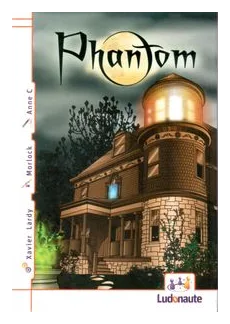
Jamestown, Virginia, at the end of the year 1907 – a tercentenary house welcomes new owners, a peaceful family. But the place is already occupied by lost souls which have been in confrontation for ages.
Core mechanisms
Key systems that shape the decisions players make.
Read the full game description
Jamestown, Virginia, at the end of the year 1907 – a tercentenary house welcomes new owners, a peaceful family. But the place is already occupied by lost souls which have been in confrontation for ages. The Standish cannot escape from this haunted house and will be the collateral damage of the conflict. In Phantom, the four areas of the house – Garden, Basement, Ground Floor and First Floor – are placed in a line, with the areas divided into two sides. Each player controls Ghosts in half of the house, and he must make Spectres, Souls and other Spirits appear in front of the different areas of the house in order to frighten the Occupants before the other player. Each turn, a player can play a card – Ghost or Place – in order to increase the Scare level of his corresponding apparition; each Place card must be played in front of its corresponding area(s); for example, the Attic must be played in the First Floor,while the Stairs can be played either in the First Floor or in the Ground Floor. (Note: In Europe, the first floor is customarily the initial floor above ground level, while in the U.S. the floor at ground level is the first floor.) The Ghost cards can be played in front of any areas. Each of them creates a special effect: The Squatter takes a Place from the opponent's apparition. The Charmer makes an Occupant come in the area. The Howler puts Occupants off the area. The Knocker discards a Ghost from the opponent's apparition. The Queen takes a Ghost of his family from the opponent's apparitions. The Invoker gets a Ghost back from the discard pile. Unfortunately for you, the adults of the family can kill off some vulnerable Ghosts, and a family of Ghosts is vulnerable to each of the adults. Some Places protect the Ghosts from the adults. At the end of a player's turn, the Scare level of the apparitions in the different areas are compared to the Fear threshold of any Occupants located there. When a player's Scare level is higher or equal to the Fear threshold of an Occupant who is alone in the corresponding area, this player takes this Occupant and wins the corresponding Victory points. After his turn, the player draws Ghost/Place cards until he has five cards in hand. Each adult is worth 3 victory points (VPs), each child 2 VPs, the baby 4 VPs, and the Priest adds 1 VP to the last Occupant of the house. As soon as a player has collected 11 VPs, the game ends, with him as the winner.