Overview
At a glance
Is this game right for my group?
ABG editorial scores on a 1–5 scale.
Harder to teach
High replayability
Highly interactive
Scales well
Deep strategy
How it plays
How does it play?
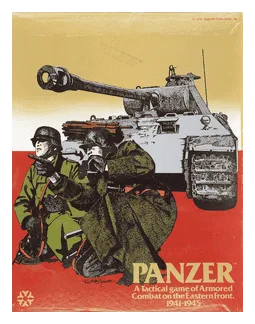
(from the box:) Panzer is a tactical-level game of ground combat on the Eastern Front in World War II.
Core mechanisms
Key systems that shape the decisions players make.
Grid Movement
Move pieces between adjacent spaces on a regular grid.
Dice Rolling
Roll dice to introduce uncertainty into actions, production, movement, or resolution.
Events
Triggered events alter the shared state, rules, or available choices.
Line of Sight
Visibility between pieces determines valid targets, movement, or effects.
Hexagon Grid
Use a hexagonal map where each space connects evenly in six directions.
Read the full game description
(from the box:) Panzer is a tactical-level game of ground combat on the Eastern Front in World War II. The strengths and weaknesses of the German and Russian units involved are accurately and playably duplicated by forty-nine data cards that display all information needed to move and fight. The system easily incorporates myriad details such as armor thicknesses at various points, shots from various angles, heights, and altitudes, and the effects of terrain. The rules cover the important aspects of small unit tactics - armor piercing shots, small arms fire, artillery barrages, air support, communications, gun depression, mines, roadblocks, barbed wire, smoke, and much more. The scenarios cover a variety of combat situations that are resolved on the three piece geomorphic mapboard, which also features movable terrain pieces. The types of units include counters for infantry, anti-tanks guns, Panthers, Tigers, STG IIIs, Hetzers, T-34s, Stalins, SU-100s, SU-152, and much, much more.