Overview
At a glance
Is this game right for my group?
ABG editorial scores on a 1–5 scale.
Harder to teach
High replayability
Highly interactive
Scales well
Deep strategy
How it plays
How does it play?
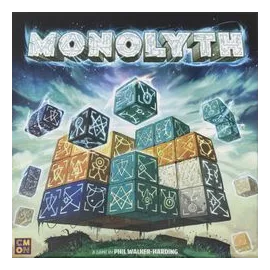
Every player builds their own block of stones in Monolyth, using 3D polyominoes to create patches of particular colors, complete levels, and a structure that matches a pattern.
Core mechanisms
Key systems that shape the decisions players make.
Read the full game description
Every player builds their own block of stones in Monolyth, using 3D polyominoes to create patches of particular colors, complete levels, and a structure that matches a pattern. To set up, choose a structure card at random, then place it on the main board, along with the appropriate structure tokens, level tokens, and prophecy tokens based on the number of players. Place the crystal marker next to the main board, then draw twelve random polyominoes from the box and place them in a circle around the main board. The polyominoes come in five colors, and all 1x1 blocks in those colors are placed to the side. On a turn, move the crystal 1-4 spaces clockwise, then take the polyomino in that space and add it to your 4x4 player board, with nothing placed outside that grid and no part of the polyomino hanging over an empty space; alternatively, you can remove this polyomino from the game and take a 1x1 block of the same color, then add that to your player board. In either case, draw a random polyomino from the box and place it where the crystal started this turn. Instead of moving the crystal, you can choose a prophecy token from the main board and add it to a side of your player board. Each player board has four different colors around the four edges, e.g., blue, orange, black, and teal. When you fill all the spaces of a level on your player board, take the largest level token from the main board. If your construction fits the guidelines of the structure card, then you claim the highest available structure token. Keep taking turns until someone has completed their 3D monolith, which is 4x4x3 in a 3-4 player game and 4x4x4 in a 1-2 player game, after which you finish the round. If a prophecy has been fulfilled, e.g., if you placed a 12 on the orange side of your player board and you have at least 12 orange blocks on that edge of your player board, then you score points equal to that prophecy token. Sum the points of your structure token, level tokens, and valid prophecy tokens to see who has the highest score and wins.