Table feel
Metallum has a high level of direct confrontation and strategic depth, with frequent interaction among players. However, it does not require much cooperation.
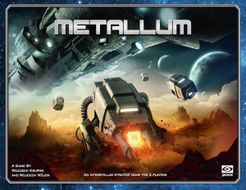
When it turned out that faster-than-light travel was deadly for every lifeform, humans sent their inventions out instead to explore the galaxy — colossal factory ships capable of building and deploying automated Extractors. Those ships drilled, mined and transported raw minerals...
Players
2
Time
?-?
Age
10+
Weight
2.67
Rating
6.99
Should this hit the table?
Metallum has a high level of direct confrontation and strategic depth, with frequent interaction among players. However, it does not require much cooperation.
Teaching signal
High replayability
Highly interactive
Scales well
Deep strategy
Luck-sensitive
Metallum has a high level of direct confrontation and strategic depth, with frequent interaction among players. However, it does not require much cooperation.
Metallum offers a high level of variability with its gameboard, expansions, and strategic depth. The game scales well with different player counts and provides an engaging experience. While it may take some time to learn, the depth it offers makes it worth the investment. Overall, Metallum has a strong replayability score of 8.0.
Metallum has a moderate level of luck involved in the game. Random elements like dice rolls or card draws have a notable but not exclusive impact on the game outcome. While there is some room for players to influence or mitigate the effects of randomness through strategic decisions, luck still plays a significant role. The game has a balanced mix of luck and strategy, making it suitable for players who enjoy a combination of chance and skill.
Overview
When it turned out that faster-than-light travel was deadly for every lifeform, humans sent their inventions out instead to explore the galaxy — colossal factory ships capable of building and deploying automated Extractors. Those ships drilled, mined and transported raw minerals from faraway planetary systems back to Earth. Soon hundreds upon hundreds of star systems were visited and their planets were drilled down to their cores and stripped of valuable resources. After the ships moved on to the next system, the leftover excavation installations still lingered as a grim sign of past mining operations. In no time, two corporations monopolized the galaxy mining business, but with myriad systems to exploit they remained in a state of uneasy peace — a peace about to be broken due to an automated analysis of reports from a system mined many decades ago that yielded something weird, that led to a discovery of...Metallum. This new substance, which seems to carry a promise for interstellar travel for living organisms, is bound to stir conflict. The Earth Government immediately steps in and claims ownership of the system in the name of the "good of mankind", but it's clear that one of the two corporations will be afforded the exclusive rights to extract Metallum – and the huge profits that come with it. The tension raises instantly. Outright corporate war is avoided only thanks to a promise to grant the mining rights to the corporation that will develop more efficient mining infrastructure on the planets. Incidents are bound to happen with old installations used to destroy enemy Extractors since it's clear that the Earth Government will be handing their grants based on Metallum extraction rates of each corporation before finally awarding exclusive mining rights to one of them. The best pilots from each corporation sit down behind their consoles as their factory ships approach the system with production of Extractors set to maximum. Metallum is a strategy game for two players who take on roles of corporate pilots charged with the task of directing their factory ships in order to construct a more efficient mining network on the system's planets than their opponent does. Each round consists of three main phases: Programming: Players simultaneously create a program by composing puzzle-like subroutines that activate various systems on the factory ship (engines for moving, production for deploying Extractors, etc.). Some of the more powerful subroutines take more time to execute and hence impede your ability to react to the other player's moves — and they might even prevent you from activating other ship systems. Action: Players execute programs composed during the programming phase. Since the order of execution of subroutines is decided by the player, the same program can yield vastly different outcomes, which leads to many interesting tactical decisions. During this phase new Extractors are also deployed on the system's planets. Profits: Players earn credits for the planets on which they have their Extractors depending on who has more of them. After nine rounds, the pilot who's earned the most credits for his corporation is declared the winner. Will you be able to cover the planets of the system with a network of your Extractors and at the same time disturb the plans of your opponent? Although the conflict is officially only an economic one, the successful pilot needs to know when to strike at a rival's mining infrastructure or make "slight modification" to it. When all is said and done, nobody will remember the details of the struggle — only the name of the greatest pilot in the history of the galaxy.
Media
Images, galleries, and videos are grouped here so the page feels visual before every asset is fully hosted.
Editions
| Edition | Year | Language | Publisher / Region |
|---|---|---|---|
| No editions imported yet. | |||
Files and documents
No files imported yet.
Commerce mapping
No commerce mappings imported yet.
Credits
Linked items
Related games and expansions help build a connected catalog around every title.
No linked items imported yet.