Overview
At a glance
Is this game right for my group?
ABG editorial scores on a 1–5 scale.
Harder to teach
High replayability
Highly interactive
Scales well
Deep strategy
How it plays
How does it play?
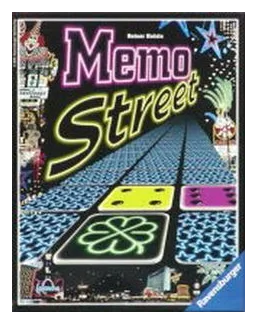
Memo Street combines the classic games of Memory and Yahtzee. A game consists of ten rounds.
Core mechanisms
Key systems that shape the decisions players make.
Read the full game description
Memo Street combines the classic games of Memory and Yahtzee. A game consists of ten rounds. In each round the players attempt to cover one of the ten rows on their scoreboard with tiles, trying to score the maximum number of points as they do so. The board is established by laying the tiles face down on the table in a rectangular grid. On a player's turn, they turn over any three tiles. The player then picks one of the 10 rows (1, 2, 3, 4, etc.) on their scoreboard and places one, two, or three of the tiles on their scoreboard, provided they fit. Any tiles that can't be used are left on the table and turned over again where they are. No tiles may be added to or removed from a row on a scoreboard that contains only one or two tiles. If none of the tiles turned up can fit on a free row, the player must declare one of his free rows invalid by placing one of the tiles turned up face down on the first square of the row (the others are returned to the table face down). Game ends after the tenth round, and the winner is the one with the most points.