ABG All Board Games
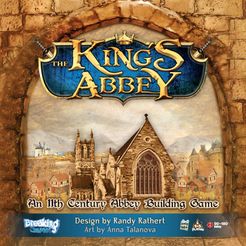
The King's Abbey box art
Rich game profile

The King's Abbey

In AD 1096, hope fills the air like a bird's song after a long winter, the seeming endless road of the Dark Ages may soon come to an end. For years now, warlords have roamed the land, every surface is covered with filth, and disease has ripped through towns like great tornadoes....

Players

1-5

Time

90-180

Age

14+

Weight

3.25

Rating

6.91

Should this hit the table?

Quick read before the metadata.

The King's Abbey has a high level of direct confrontation and strategic depth in confrontation. Players need to frequently pay attention to and react to each other's strategies and turns. However, the level of cooperation required is relatively low.

Teach 2.3

Teaching signal

Replay 3.9

High replayability

Interaction 3.8

Highly interactive

Scaling 4.0

Scales well

Strategy 4.5

Deep strategy

Control 3.5

More strategic control

Table feel

The King's Abbey has a high level of direct confrontation and strategic depth in confrontation. Players need to frequently pay attention to and react to each other's strategies and turns. However, the level of cooperation required is relatively low.

Replay value

The King's Abbey offers a high level of variability with its gameboard, allowing for different experiences each time it is played. The presence of expansions adds new content and gameplay elements, enhancing replay value. The game provides deep strategic possibilities and room for players to improve their tactics over time. The player interaction score is fixed at 3.8. The game scales well with different numbers of players without compromising its appeal or balance. While it may take some time to learn, the game offers a good balance between easiness and depth. Overall, The King's Abbey has a strong replayability score of 7.8.

Luck profile

The King's Abbey has a moderate level of luck involved in the game. Random elements such as dice rolls and card draws have a notable but not exclusive impact on the game outcome. However, players have substantial ability to mitigate the effects of luck through strategic decisions and planning. The game outcome is primarily determined by player strategy and decisions, with luck playing a minor role. Overall, The King's Abbey strikes a good balance between luck and strategy.

Overview

What ABG knows about this game

In AD 1096, hope fills the air like a bird's song after a long winter, the seeming endless road of the Dark Ages may soon come to an end. For years now, warlords have roamed the land, every surface is covered with filth, and disease has ripped through towns like great tornadoes. King Sivolc has dreamed that building a great gothic structure is the answer to leave this Dark Age behind forever. But for the last decade, there has been a massive decline in the building activity, and hardly any great cultural achievements have been made. Recently, while on one of his crusades, King Sivolc met a master architect named Elias. Elias told the King about his devotion to the mortar arts and how he longed to build a structure so great that people would travel hundreds of miles just to gaze at it. This meeting created a spark that ignited the King’s dream with a fire that would burn away even the darkest of days forever. King Sivolc looks on from his castle and watches with great expectation as his dream becomes a reality. With Elias’ help, he has hired some of the greatest architects and monks in the land to complete this task. He waits patiently for this great abbey to be raised from the earth, filled with people, changing the course of history forever! The King's Abbey is a worker placement/resource management game in which each player has their own player board that represents the abbey they have been tasked to build. Players take charge of monks that are represented by ten dice as they go out and gather resources, go on crusades, construct buildings, train clergy, bring in peasants, and defend their abbey against the darkness. Each player does this by rolling their dice and then assigning each die (monk) to different places on their player board, resource boards, and crusade cards. The places on the player boards will bring in peasants and train clergy. The places on the resource boards will give them wood, grain, stone, and sand for building the various parts of their individual abbeys. Each player receives prestige (victory points) for completing crusades and constructing various things in their abbey such as towers and different kinds of buildings. The game proceeds over a total of seven rounds where the "darkness" becomes greater each round. The darkness represents things like depression, famine, raiders attacking, and other things that the Dark Ages brought with it. You fight the darkness by keeping the defenses of your abbey strong. Players are trying to have the most prestige than any other player by the end of the seventh round. After seven rounds, players add up all prestige earned. Whoever has the most prestige wins the game!
Media

Images and visual references

Images, galleries, and videos are grouped here so the page feels visual before every asset is fully hosted.

Editions

Versions and regional releases

Edition Year Language Publisher / Region
No editions imported yet.

Files and documents

Rules, aids, translations

No files imported yet.

Commerce mapping

Buying signals

No commerce mappings imported yet.

Credits

People and publishers

Linked items

Graph expansion queue

Related games and expansions help build a connected catalog around every title.

No linked items imported yet.