Table feel
Moderate level of direct and strategic confrontation with high interaction frequency, but low emphasis on cooperation.
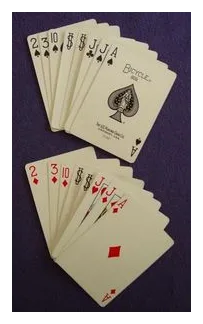
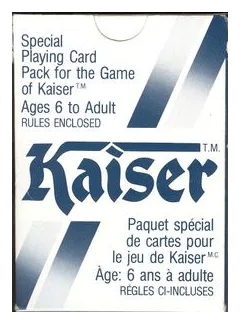
Kaiser is a Canadian trick-taking card game for four played in partnerships. The game uses a 32-card French-suited deck with a tweaked distribution: AKQJT98 in all suits, plus 7?, 7?, 5?, and 3?. Bids are made for how many tricks will be taken, and the winner names the trump suit...
Players
?-?
Time
?-?
Age
?+
Weight
1.8
Rating
7.11
Should this hit the table?
Moderate level of direct and strategic confrontation with high interaction frequency, but low emphasis on cooperation.
Teaching signal
High replayability
Highly interactive
Scales well
Deep strategy
More strategic control
Moderate level of direct and strategic confrontation with high interaction frequency, but low emphasis on cooperation.
Kaiser has a high variability gameboard, offering different experiences each time it is played. The presence of expansions adds new content and gameplay elements, enhancing replay value. The game provides deep strategic possibilities and room for improvement. Player interaction is moderate. It scales well with different numbers of players without compromising its appeal or balance. The game is moderately easy to learn, offering a balance between depth and accessibility. Overall, Kaiser has a strong replayability score of 7.9.
Kaiser has a moderate level of randomness impact, with random elements having a notable but not exclusive impact on the game outcome. However, players have substantial ability to mitigate randomness through strategic decisions and planning. The game outcome is primarily determined by player strategy and decisions, with luck playing a minor role.
Overview
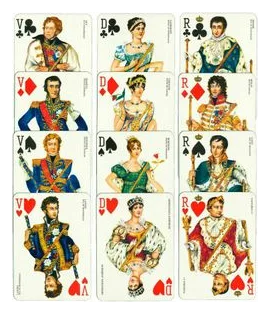
Kaiser is a Canadian trick-taking card game for four played in partnerships. The game uses a 32-card French-suited deck with a tweaked distribution: AKQJT98 in all suits, plus 7?, 7?, 5?, and 3?. Bids are made for how many tricks will be taken, and the winner names the trump suit. Points are added or subtracted depending on whether the bid is made. Each trick is worth a point. Winning the 5? or 3? is worth +5 or -3, respectively. The game has been around for at least 40 years and it is often believed that it has its origins in the Ukrainian culture, possibly being brought over by immigrants to Canada. The Pagat database and newer research indicate that it was introduced in the 1920s or 1930s and is a version of the traditional card-games Three-spot and Troika, but was re-named with the influence of the card game Joffre that was originally called "Shoo le Kaiser". Re-implementation of: Joffre Lost Heir (Kaiser has absolutely no connection with the ancient Swiss card game called Kaiserspiel or Kaiserjass.)
Media
Images, galleries, and videos are grouped here so the page feels visual before every asset is fully hosted.
No media imported yet.
Editions
| Edition | Year | Language | Publisher / Region |
|---|---|---|---|
| No editions imported yet. | |||
Files and documents
No files imported yet.
Commerce mapping
No commerce mappings imported yet.
Credits
Linked items
Related games and expansions help build a connected catalog around every title.
No linked items imported yet.