Table feel
Moderate level of direct and strategic confrontation with high interaction frequency, but low emphasis on cooperation.
Compete for contested options while managing cost and timing.
Players
2-5
Play time
Not listed
Age
10+
Complexity
1/5
Rating
5.95
Group fit
ABG editorial scores on a 1–5 scale.
Harder to teach
High replayability
Highly interactive
Scales well
Deep strategy
More strategic control
Moderate level of direct and strategic confrontation with high interaction frequency, but low emphasis on cooperation.
The game offers a high degree of variability with different experiences each time it is played. The presence of expansions adds new content and gameplay elements. There is deep strategic depth and room for players to improve their strategy over time. The game scales well with different numbers of players without compromising its appeal or balance. It is moderately easy to learn with a good balance between depth and accessibility. Overall, Jade Merchant has a strong replayability score.
Jade Merchant has a moderate level of luck involved in the game. Random elements such as dice rolls and card draws have a notable but not exclusive impact on the game outcome. However, players have substantial ability to mitigate the effects of randomness through strategic decisions and planning. The game outcome is primarily determined by player strategy and decisions, with luck playing a minor role. Overall, Jade Merchant strikes a good balance between luck and strategy.
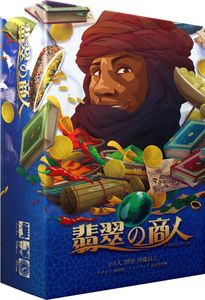
In ????? (Jade Merchant), players are the heads of trader caravans who try to accumulate the most valuable goods like gold, spices, and jade. Each round, they have to outbid each other backwards so that the least greedy one may choose the first cards of the current pool; more spe...
In ????? (Jade Merchant), players are the heads of trader caravans who try to accumulate the most valuable goods like gold, spices, and jade. Each round, they have to outbid each other backwards so that the least greedy one may choose the first cards of the current pool; more specifically, each player in turn declares how many cards they want to take, and whoever declares the smallest number takes that many cards. (A player can declare 0.5 less than the number they want to take, and if they do so, they return one card from their hand to the center.) The remaining players then bid for the rest of the cards, with this process repeating until each player takes cards. Each treasure has its own scoring rules depending on how many you have or how they combine with other cards in your collection. After resolving all cards this way, the player with the highest value of goods wins.
Shopping
Compare listed prices, then confirm the edition, shipping, and availability with the retailer.
No live prices are available yet. The shopping references below may still help.
Box art, components, and videos that help you understand the game.
Language and publisher variants currently recorded in the catalog.
| Edition | Year | Language | Publisher / Region |
|---|---|---|---|
| No editions imported yet. | |||
Rulebooks, player aids, FAQs, and solo resources.
No files imported yet.
No published linked games yet.