Table feel
Hex has a high level of direct confrontation and strategic depth, with frequent interaction between players. However, it does not require much cooperation.
Hex was invented by the Danish mathematician and poet Piet Hein, who introduced the game in 1942 at the Niels Bohr Institute. The same year Hex appeared in the Danish newspaper Politiken under the name Polygon. Hein introduced the game to the readers on December 26, 1942 and duri...
Players
2
Time
?-?
Age
8+
Weight
3.16
Rating
6.70
Should this hit the table?
Hex has a high level of direct confrontation and strategic depth, with frequent interaction between players. However, it does not require much cooperation.
Teaching signal
High replayability
Highly interactive
Scales well
Deep strategy
More strategic control
Hex has a high level of direct confrontation and strategic depth, with frequent interaction between players. However, it does not require much cooperation.
Hex offers a high level of variability with its gameboard, allowing for different experiences each time it is played. The presence of expansions adds to the replay value, although there is room for improvement in terms of their impact. The game offers deep strategic possibilities and allows players to discover new tactics and strategies over time. The player interaction score is average. Hex scales well with different numbers of players without compromising its appeal or balance. The game falls within the range of moderate easiness to learn, offering a balance between accessibility and depth. Overall, Hex has a solid replayability score of 7.7, indicating its ability to provide fresh and engaging experiences over multiple playthroughs.
Hex has a moderate influence of luck. Random elements have a notable but not exclusive impact on the game outcome. Players have substantial ability to mitigate randomness through strategic decisions and planning. The game outcome is primarily determined by player strategy and decisions, with luck playing a minor role.
Overview
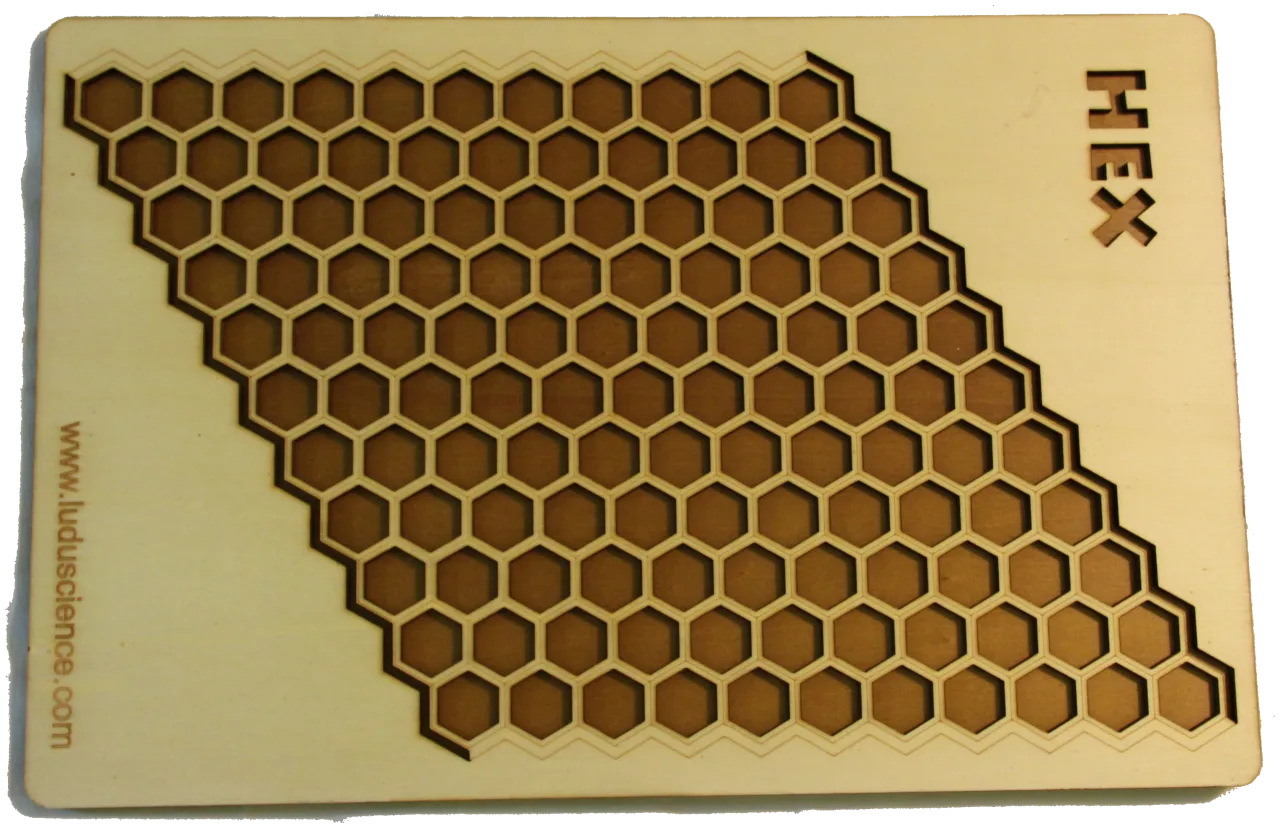
Hex was invented by the Danish mathematician and poet Piet Hein, who introduced the game in 1942 at the Niels Bohr Institute. The same year Hex appeared in the Danish newspaper Politiken under the name Polygon. Hein introduced the game to the readers on December 26, 1942 and during the following four months gave them a problem each day to begin with - eventually two days a week, on Wednesdays and Saturdays. The solution would always appear in the following column. It was independently invented by mathematician John Nash in 1947 at Princeton University. In 1952, Parker Brothers marketed a version. They called their version Hex, and the name stuck. Hex has the simplest rules of almost any game: connect your color edges with a path of tokens of your color. There is also a "swap rule" (also known as a pie rule) which compensates for the inherent advantage of the first player. There are a number of resources for Hex on the internet, including several real-time servers. If you want to play face-to-face, used Hex sets are occasionally available, and you can also make your own set. A Battlemat with 1" hexes can be cut into a 15x15 rhombus grid. Standard Go stones also work well for this board. It is also playable as a pencil-and-paper game, like the 3M Paper Game version.
Media
Images, galleries, and videos are grouped here so the page feels visual before every asset is fully hosted.
Editions
| Edition | Year | Language | Publisher / Region |
|---|---|---|---|
| No editions imported yet. | |||
Files and documents
No files imported yet.
Commerce mapping
No commerce mappings imported yet.
Credits
Linked items
Related games and expansions help build a connected catalog around every title.
No linked items imported yet.