Table feel
Moderate level of direct confrontation and strategic depth, with high frequency of interaction. Limited emphasis on cooperation.
This light strategy game is divided into two Epochs, ancient and modern. At the start, the board consists of only five areas (the Mediterranean, Africa, Middle East, India and China), after all areas have been evaluated, four more territories become accessible (Russia, Europe, So...
Players
2-5
Time
?-?
Age
10+
Weight
2.16
Rating
6.40
Should this hit the table?
Moderate level of direct confrontation and strategic depth, with high frequency of interaction. Limited emphasis on cooperation.
Teaching signal
High replayability
Highly interactive
Scales well
Deep strategy
More strategic control
Moderate level of direct confrontation and strategic depth, with high frequency of interaction. Limited emphasis on cooperation.
Heroes of the World offers a high degree of variability with its gameboard, allowing for different experiences each time it is played. The presence of expansions adds new content and gameplay elements, further enhancing replay value. The game also provides deep strategic possibilities and room for players to improve their tactics and strategies over time. With good scalability and moderate easiness to learn, Heroes of the World achieves a strong replayability score of 7.92.
Heroes of the World has a moderate influence of luck. Random elements have a notable but not exclusive impact on the game outcome. Players have substantial ability to mitigate randomness through strategic decisions and planning. The game outcome is primarily determined by player strategy and decisions, with luck playing a minor role.
Overview
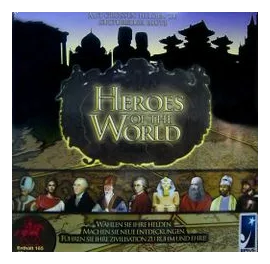
This light strategy game is divided into two Epochs, ancient and modern. At the start, the board consists of only five areas (the Mediterranean, Africa, Middle East, India and China), after all areas have been evaluated, four more territories become accessible (Russia, Europe, Southeast Asia, America). Players choose historical "Heroes" such as Julius Cesar, Nebuchadnezzar, Lao-Tse, Shakespeare or Mozart and use their special abilities; the first is to grow the population in one or more of the nine areas of the map (depending on the hero, only certain areas of the map can be used). The second action is to randomly draw cultural advancement tokens and place them on the map. The third action allows the players to attack other players' pieces, and the fourth action is taking money. With money, "wonders of the world", such as the Hanging Gardens, the Great Wall etc., can be purchased, and migrations of peoples are possible. Victory points are awarded for building civilization tokens; after three (or four, depending on the territory) placements, the player with the most pieces gets additional points, the player with second most armies half of that, while the third player only gets victory points equal to the lowest token.
Media
Images, galleries, and videos are grouped here so the page feels visual before every asset is fully hosted.
Editions
| Edition | Year | Language | Publisher / Region |
|---|---|---|---|
| No editions imported yet. | |||
Files and documents
No files imported yet.
Commerce mapping
Credits
Linked items
Related games and expansions help build a connected catalog around every title.
No linked items imported yet.