Overview
At a glance
Is this game right for my group?
ABG editorial scores on a 1–5 scale.
Harder to teach
High replayability
Highly interactive
Scales well
Deep strategy
How it plays
How does it play?
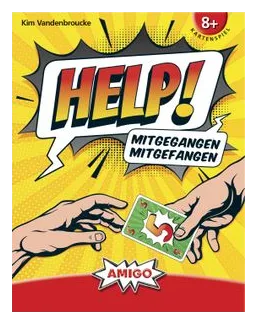
In HELP!, you don't want to be stuck unable to play a card or unable to help a neighbor play. The game is played in rounds that alternate in clockwise and counter-clockwise order.
Core mechanisms
Key systems that shape the decisions players make.
Read the full game description
In HELP!, you don't want to be stuck unable to play a card or unable to help a neighbor play. The game is played in rounds that alternate in clockwise and counter-clockwise order. The deck of cards is numbered 1-11, with more of the higher cards than lower ones; four types of special cards are also included in the deck. Deal each player a hand of four cards, then create a space next to the deck that can hold up to six cards. Whoever has the lowest card in hand plays that card next to the deck, then refills their hand. Each player in turn plays a higher card, and when the sixth card is played in the row, discard all six cards, with the next player then playing whatever card they want. If you can't play on a turn, ask the previous player whether they have a card you can play; if they do, the two of you exchange cards, then you play. You can play special cards — or pass them to or receive them from a neighbor — to get you out of a jam: X is a joker that can be inserted in the middle of a row or at the end, and it counts as one higher than whatever card it's next to. Switch allows you to replace a card in the row with a different card from your hand as long as the row is still in ascending order. Zap removes the last card in the row. No!, which is placed in front of you, serves as your play for the turn and also skips your next turn; additionally, you are skipped when a neighbor needs help. If you can't play a card and a neighbor can't help you, then the round ends and each other player scores 1 point. Alternatively, if you can't play and everyone else has a No! in front of them, which prevents them from helping, the round ends and you score 1 point because they failed you in that moment. Keep playing rounds until one or more players have 3 points and win the game.