Overview
At a glance
Is this game right for my group?
ABG editorial scores on a 1–5 scale.
Harder to teach
High replayability
Highly interactive
Scales well
Deep strategy
How it plays
How does it play?
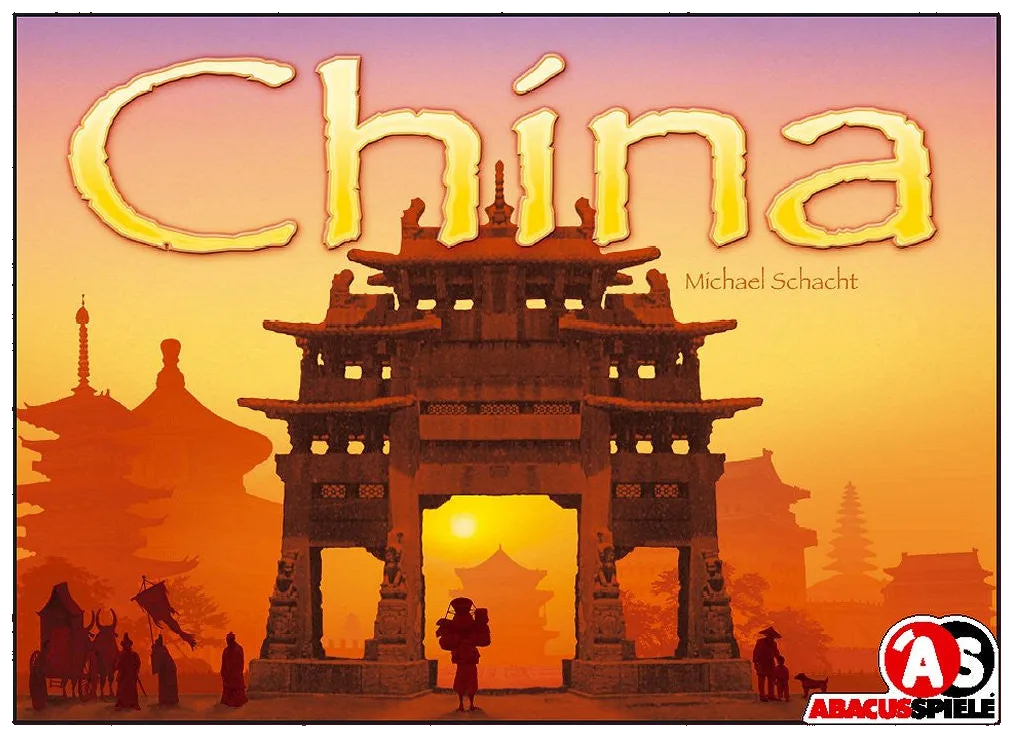
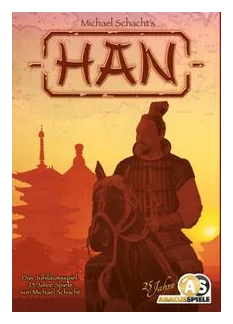
For the most part, Han uses the same gameplay as China, also from designer Michael Schacht, but the maps on the double-sided game board introduce new rules and variants. In general, players use cards to place pieces (houses or emissaries) into the nine regions on the board.
Core mechanisms
Key systems that shape the decisions players make.
Area Majority
Compete to have the strongest presence in areas that award control or points.
Open Drafting
Select cards or items from a shared face-up display.
Hand Management
Time and sequence a limited hand of cards to preserve future options.
Network and Route Building
Create connected routes that improve reach, delivery, control, or scoring.
Read the full game description
For the most part, Han uses the same gameplay as China, also from designer Michael Schacht, but the maps on the double-sided game board introduce new rules and variants. In general, players use cards to place pieces (houses or emissaries) into the nine regions on the board. To place in a region, a player must play a card of that region's color or two cards of the same color as a joker; a player can place at most two pieces in a region on a turn, but only one piece if the region was unoccupied at the start of the turn. One side of the game board — titled "Grenzstreitigkeiten", or "Border Disputes", and made for 3-5 players — includes house sites that straddle two regions; to claim one of these locations, a player must discard two appropriately-colored cards. The number of emissaries in a region is limited to the number of houses of the same color in that same region. When all house spaces in a region are filled (or at the end of the game), players score for that region. Whoever has the most houses in that region scores one point for each house in the region, whoever has the secondmost houses scores one point for each house of the player who has the most, and so on. At game end, players also score for having majorities of emissaries in two adjacent regions, scoring as many points as the number of emissaries in both regions. Players also score for having four or more houses in an uninterrupted sequence along one of the roads on the board. On the "Grenzstreitigkeiten" game board, players also score majority points for the houses in the port cities located in multiple regions, these port cities effectively forming their own region. Whoever scores the most points wins. "Grenzstreitigkeiten" has one variant. Each player starts with one fortification in addition to his other pieces. Once per game, a player can play two matching cards, then place his fortification on a house site, then top it with a house. Whenever this house scores — whether for the region majority, for being a port city, or for being part of a sequence — the house's owner scores double the points he normally would. The other side of the game board — "Wege der Diplomatie", or "Ways of Diplomacy", which is made for 2-4 players — also has a variant, with each player receiving a marketplace. Once per game, a player can play two matching cards, then place the marketplace on a house site, then top it with an emissary (not a house). This allows a player to compete for emissary points in a region that is otherwise full.