Overview
At a glance
Is this game right for my group?
ABG editorial scores on a 1–5 scale.
Easier to teach
High replayability
Highly interactive
Scales well
Deep strategy
More strategic control
How it plays
How does it play?
Buy deeds, fit polyomino buildings into a shared city, and balance population, commerce, civic glory, and income across three years.
Core mechanisms
Key systems that shape the decisions players make.
Tile Placement
Place tiles to build a shared or personal spatial arrangement.
Income
Receive recurring resources according to your position, assets, or development.
Ownership
Claim assets or areas that remain under a player’s control.
Market
Buy and sell through a shared supply whose availability or prices can change.
Auction: Dutch
Bid against other players to determine who receives an item, action, or priority.
Square Grid
Use an orthogonal grid where position and adjacent spaces shape movement or placement.
Read the full game description
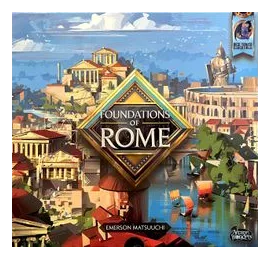
Foundations of Metropolis distills the land market and city puzzle of Foundations of Rome into an accessible cardboard edition. Every player begins with a personal board holding their building tiles, while a shared square grid represents the developing city. On a turn, take one clear action: purchase an available deed to claim its numbered lot, construct a building on contiguous lots you own, or collect income. Residential buildings add population, commercial buildings generate money, and civic buildings score according to the neighboring structures around them, so placement creates both cooperation and competition. At the end of each of three years, population and commerce are scored before new, more valuable buildings become available. Larger polyominoes require careful deed purchases and can overwrite earlier construction, making timing as important as spatial efficiency. Quick setup and visible components keep the rules approachable while auctions, adjacency, and a shared board produce lively interaction.