ABG All Board Games
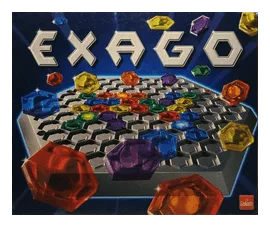
Exago box art
Rich game profile

Exago

The game is played on a hexagonal board. Each player is given six hexagonal tiles of one color (twelve, in a two-player game). In turn, players put one of their tiles on the board, with the goal of getting four-in-a-row, in a straight line. Each new tile must be placed adjacent t...

Players

2-6

Time

?-?

Age

9+

Weight

1.41

Rating

5.58

Should this hit the table?

Quick read before the metadata.

Moderate interaction

Teach 2.3

Teaching signal

Replay 4.0

High replayability

Interaction 3.6

Highly interactive

Scaling 4.0

Scales well

Strategy 4.5

Deep strategy

Control 3.5

More strategic control

Table feel

Moderate interaction

Replay value

Exago has a high variability gameboard, offering different experiences each time it is played. The presence of expansions adds new content and gameplay elements, enhancing replay value. The game provides deep strategic possibilities and allows players to improve their strategies over time. The player interaction score is average. Exago scales well with different numbers of players without compromising its appeal or balance. While it may take some time to learn, it offers a good balance between easiness and depth. Overall, Exago has a high replayability score of 8.0.

Luck profile

Exago has a moderate level of luck influence. Random elements have a notable but not exclusive impact on the game outcome. Players have substantial ability to mitigate randomness through strategic decisions and planning. The game outcome is primarily determined by player strategy and decisions, with luck playing a minor role.

Overview

What ABG knows about this game

The game is played on a hexagonal board. Each player is given six hexagonal tiles of one color (twelve, in a two-player game). In turn, players put one of their tiles on the board, with the goal of getting four-in-a-row, in a straight line. Each new tile must be placed adjacent to another one (not necessarily of their own color). When a player has no more tiles, they can move a tile of their own color to another position. If a group of tiles is isolated due to moving a tile, all isolated tiles (of the smallest group) return to their respective owners, to be used again. The first to have four pieces in a straight line wins the game. (In this game, a player MUST block the player to their left if that player is in a position to win - even if more than one player is able to win on their next turn.)

Media

Images and visual references

Images, galleries, and videos are grouped here so the page feels visual before every asset is fully hosted.

No media imported yet.

Editions

Versions and regional releases

Edition Year Language Publisher / Region
No editions imported yet.

Files and documents

Rules, aids, translations

No files imported yet.

Commerce mapping

Buying signals

No commerce mappings imported yet.

Credits

People and publishers

Designers

1
Mark Forsyth

Artists

1
Kinetic

Publishers

2
Goliath Games Paradys Games

Linked items

Graph expansion queue

Related games and expansions help build a connected catalog around every title.

No linked items imported yet.