Table feel
Esels-Rennen has a high level of direct confrontation and strategic depth in confrontation. Players need to frequently pay attention to and react to others' strategies and turns. However, there is less emphasis on cooperation in the game.
First issued in 1989 for fewer players, the second edition (released in 1996) is for 2-6 players. The board has two sides, for racing either 3 or 4 colored donkeys. Players are given a card secretly, each showing the donkey's finishing order, a different result for each card. The...
Players
2-6
Time
?-?
Age
8+
Weight
1.17
Rating
5.51
Should this hit the table?
Esels-Rennen has a high level of direct confrontation and strategic depth in confrontation. Players need to frequently pay attention to and react to others' strategies and turns. However, there is less emphasis on cooperation in the game.
Teaching signal
High replayability
Highly interactive
Scales well
Deep strategy
Luck-sensitive
Esels-Rennen has a high level of direct confrontation and strategic depth in confrontation. Players need to frequently pay attention to and react to others' strategies and turns. However, there is less emphasis on cooperation in the game.
esels-rennen has a high replayability score due to its high variability gameboard, availability of expansions, deep strategic possibilities, and good scalability. The game offers fresh experiences each time it is played, allowing players to discover new tactics and strategies. The player interaction score is average, but the game adapts well to different player counts without compromising its appeal or balance. While the game may take some time to learn, it offers a good balance between easiness and depth.
Esels-Rennen has a low influence of luck. While random elements like dice rolls or card draws have a significant impact on the game outcome, players have substantial ability to mitigate randomness through strategic decisions and planning. The game heavily depends on luck, but player strategy and decisions play a minor role in determining the final outcome.
Overview
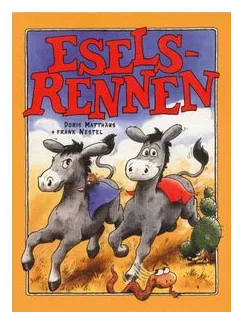
First issued in 1989 for fewer players, the second edition (released in 1996) is for 2-6 players. The board has two sides, for racing either 3 or 4 colored donkeys. Players are given a card secretly, each showing the donkey's finishing order, a different result for each card. The board shows a patchwork of steps across a field from start to finish, each space with a colored arrow matching the donkeys. When you move a donkey onto a space marked with a green arrow pointing left, you then move the green donkey one space that way. If that space then has a blue arrow pointing right, you next move the blue donkey on one space that way. This goes on until you cannot move the final donkey because it is blocked. Eventually, the donkeys cross the finish line, and the player with the best matching result on their card wins. More of a competitive puzzle than a game, it is a nice diversion, but awkward because the donkeys constantly fall on their sides. Possibly Doris & Frank's first game and related to their Bunny Zick-Zack. 3rd Place 1989 Hippodice Spieleautorenwettbewerb (as Donky [sic]).
Media
Images, galleries, and videos are grouped here so the page feels visual before every asset is fully hosted.
No media imported yet.
Editions
| Edition | Year | Language | Publisher / Region |
|---|---|---|---|
| No editions imported yet. | |||
Files and documents
No files imported yet.
Commerce mapping
No commerce mappings imported yet.
Credits
Linked items
Related games and expansions help build a connected catalog around every title.
No linked items imported yet.