Table feel
Moderate level of direct confrontation and strategic depth, with frequent interaction and limited emphasis on cooperation.
Manage cards in hand to time plays, combos, and scoring windows.
Players
2-4
Play time
Not listed
Age
7+
Complexity
1.38/5
Rating
6.28
Group fit
ABG editorial scores on a 1–5 scale.
Harder to teach
High replayability
Highly interactive
Scales well
Deep strategy
Luck-sensitive
Moderate level of direct confrontation and strategic depth, with frequent interaction and limited emphasis on cooperation.
Donburiko offers a high level of variability with its gameboard, allowing for different experiences each time it is played. The presence of expansions adds additional content and gameplay elements, enhancing replay value. The game also provides deep strategic possibilities and room for players to improve their tactics over time. With good scalability and moderate easiness to learn, Donburiko has a strong replayability score of 7.92.
Donburiko has a moderate influence of luck. Random elements have a notable but not exclusive impact on the game outcome. While players have some ability to mitigate randomness through strategic decisions, luck still plays a significant role in the game. The game outcome is a balanced mix of luck and strategy.
Players in Donburiko (?????) need to grab acorns while staying out of the ponds, as acorns don't appreciate spending lots of time in the water. (The game's setting comes from the children's nursery song "Donguri Korokoro" (????????), in which acorns roll down from the hills into...
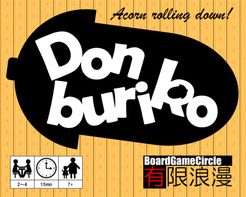
Players in Donburiko (?????) need to grab acorns while staying out of the ponds, as acorns don't appreciate spending lots of time in the water. (The game's setting comes from the children's nursery song "Donguri Korokoro" (????????), in which acorns roll down from the hills into the ponds, first excitedly playing with the loaches – a type of freshwater fish – only to then pine for the mountain left behind. The last line of the song: "He cried and the loach didn't know what to do.") Each player starts with a few chips, each worth a point. The 16-card deck – which consists of two loaches (worth 0), four ponds (worth -1 or -2) and ten acorns (worth 1-5) – is shuffled, then a number of cards equal to the number of players are laid face-up. Each player receives a hand of 3-4 cards. On a turn, a player either places a card from his hand into one of the columns or claims one of the columns. When placing a card, he can lay it face-up (taking one chip from the bank) or face-down (placing one of his chips on the card); when taking a column, it must have at least two cards and at most six. After taking a column, the player sums the cards in that column, with a loach turning the negative ponds positive and with two of the acorns worth either 1 or 5 at the player's discretion. If the column's sum is between 0-6, the player takes that many chips from the bank; if more than 6 or less than 0, he pays the difference to the bank. This player is then out of the round, while the others continue to play cards or take columns. A round ends when no columns remain, columns with only one card remain, or someone scores 6 chips from a column; in the latter case, the round ends immediately, and no one else scores anything. Players then start a new round. When the bank empties or a player has 20 or more chips, players complete the current round, then the player with the most chips wins!
Shopping
Compare listed prices, then confirm the edition, shipping, and availability with the retailer.
No live prices are available yet. The shopping references below may still help.
Box art, components, and videos that help you understand the game.
Language and publisher variants currently recorded in the catalog.
| Edition | Year | Language | Publisher / Region |
|---|---|---|---|
| No editions imported yet. | |||
Rulebooks, player aids, FAQs, and solo resources.
No files imported yet.
No published linked games yet.