Table feel
Moderate level of direct and strategic confrontation with high interaction frequency, but low emphasis on cooperation.
In the quick, spatial, tactical dice game Omba, players try to block one another on the tiny game pitch, which measures only 3×3 squares. All pieces start off the pitch. On a turn, a player rolls the die and either moves a piece on the pitch or enters a piece onto the middle squa...
Players
2-4
Time
?-?
Age
8+
Weight
1.44
Rating
5.70
Should this hit the table?
Moderate level of direct and strategic confrontation with high interaction frequency, but low emphasis on cooperation.
Teaching signal
High replayability
Highly interactive
Scales well
Deep strategy
Luck-sensitive
Moderate level of direct and strategic confrontation with high interaction frequency, but low emphasis on cooperation.
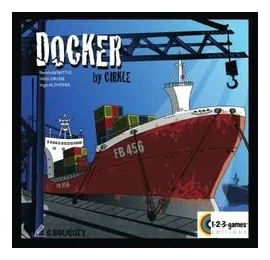
The game Docker has a high replayability score due to its high variability gameboard, availability of expansions, deep strategic possibilities, and good scalability. It offers a fresh and different experience each time it is played, allowing players to discover new tactics and strategies. The game adapts well to different player counts without compromising its appeal or balance. While it may take some time to learn, the depth it offers makes it worth the effort.
The final luck score for Docker is 6.33, indicating a balanced mix of luck and strategy. Random elements have a notable but not exclusive impact on the game outcome, and players have substantial ability to mitigate randomness through strategic decisions and planning. The game outcome is primarily determined by player strategy and decisions, with luck playing a minor role.
Overview
In the quick, spatial, tactical dice game Omba, players try to block one another on the tiny game pitch, which measures only 3×3 squares. All pieces start off the pitch. On a turn, a player rolls the die and either moves a piece on the pitch or enters a piece onto the middle square of his side of the pitch. A piece must use the full die result, can move only orthogonally, and can't enter the same space twice on a move. Spaces with other pieces in them aren't off-limits, but the cost in die points to move into and out of such spaces equals one plus the altitude difference between the two spaces. When you end movement in a space with another piece, you place your piece on top of it, trapping it. Stacks can be of any height – but make sure you are able to leave again when you climb a stack! A player who cannot make a move is eliminated, but his pieces remain on the pitch. The last player who can move wins.
Media
Images, galleries, and videos are grouped here so the page feels visual before every asset is fully hosted.
No media imported yet.
Editions
| Edition | Year | Language | Publisher / Region |
|---|---|---|---|
| No editions imported yet. | |||
Files and documents
No files imported yet.
Commerce mapping
No commerce mappings imported yet.
Credits
Linked items
Related games and expansions help build a connected catalog around every title.
No linked items imported yet.