Table feel
Crossways has a moderate level of direct confrontation and strategic depth. Players need to pay attention to each other's actions frequently. However, there is less emphasis on cooperation in the game.
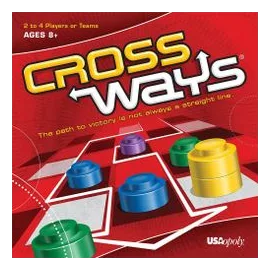
In CrossWays players want to be the first to build a path of their pieces from one side of the game board to the opposite side, but to build they need to use the cards they draw and have in hand. On a turn, a player can lay down a single card (e.g., a red 9) and place one of thei...
Players
2-4
Time
?-?
Age
8+
Weight
1.5
Rating
5.69
Should this hit the table?
Crossways has a moderate level of direct confrontation and strategic depth. Players need to pay attention to each other's actions frequently. However, there is less emphasis on cooperation in the game.
Teaching signal
High replayability
Highly interactive
Scales well
Deep strategy
More strategic control
Crossways has a moderate level of direct confrontation and strategic depth. Players need to pay attention to each other's actions frequently. However, there is less emphasis on cooperation in the game.
Crossways has a high replayability score due to its high variability gameboard, impactful expansions, deep strategic possibilities, and good scalability. It offers a fresh experience each time it is played and allows players to improve their strategies over time. The game's player interaction score is average, and it is moderately easy to learn, striking a balance between accessibility and depth.
Crossways has a moderate level of luck involved in the game. Random elements like dice rolls and card draws have a notable but not exclusive impact on the game outcome. However, players have substantial ability to mitigate the randomness through strategic decisions and planning. The game outcome is primarily determined by player strategy and decisions, with luck playing a minor role. Overall, Crossways strikes a good balance between luck and strategy, making it an engaging and enjoyable board game for players who enjoy a mix of both elements.
Overview
In CrossWays players want to be the first to build a path of their pieces from one side of the game board to the opposite side, but to build they need to use the cards they draw and have in hand. On a turn, a player can lay down a single card (e.g., a red 9) and place one of their pieces on this space on the game board; she can also lay down a pair of cards with the same value and place two of her pieces in a stack on any space, including the white ones that are otherwise off-limits. If a player has two pieces in a row on a stack, no one else can play on top of that stack – but by playing a suited run of cards, a player can remove pieces already on the board, putting those spaces into play once again.
Media
Images, galleries, and videos are grouped here so the page feels visual before every asset is fully hosted.
No media imported yet.
Editions
| Edition | Year | Language | Publisher / Region |
|---|---|---|---|
| No editions imported yet. | |||
Files and documents
No files imported yet.
Commerce mapping
Credits
Linked items
Related games and expansions help build a connected catalog around every title.
No linked items imported yet.