Table feel
Ciao! has a high level of direct confrontation and strategic depth in confrontation. Players must frequently pay attention to and react to each other's strategies and turns. However, there is minimal emphasis on cooperation in the game.
Manage cards in hand to time plays, combos, and scoring windows.
Players
2-6
Play time
Not listed
Age
7+
Complexity
1/5
Rating
5.36
Group fit
ABG editorial scores on a 1–5 scale.
Harder to teach
High replayability
Highly interactive
Scales well
Deep strategy
Luck-sensitive
Ciao! has a high level of direct confrontation and strategic depth in confrontation. Players must frequently pay attention to and react to each other's strategies and turns. However, there is minimal emphasis on cooperation in the game.
Ciao! has a high replayability score due to its high variability gameboard, impactful expansions, deep strategic possibilities, and good scalability. The game offers fresh experiences each time it is played and allows players to improve their strategy over time. The player interaction score is average, and the game adapts well to different player counts. While it may not be the easiest game to learn, it offers a good balance between ease of learning and depth of gameplay.
Ciao! has a moderate level of luck influence. Random elements have a notable but not exclusive impact on the game outcome. Players have some ability to mitigate randomness through strategic decisions and planning. The game outcome is a balanced mix of luck and strategy.
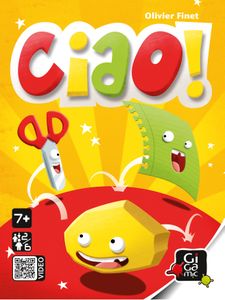
In Ciao! you want to say goodbye to the cards in your hand as quickly as possible. Each player starts with a hand of seven cards; cards show either rock, paper or scissors, and they are colored either green, yellow or red. Some cards have special icons on them, such as play again...
In Ciao! you want to say goodbye to the cards in your hand as quickly as possible. Each player starts with a hand of seven cards; cards show either rock, paper or scissors, and they are colored either green, yellow or red. Some cards have special icons on them, such as play again or draw three cards. Cards are ranked in typical RPS order, but red beats yellow, which beats green. On a turn, you play a card to the discard pile that beats the card showing on top, whether by playing paper on rock or by playing a higher ranked paper than what's already there. If you can't play, you draw one card, then play that card if possible. The first player to empty their hand wins!
Shopping
Compare listed prices, then confirm the edition, shipping, and availability with the retailer.
Box art, components, and videos that help you understand the game.
Language and publisher variants currently recorded in the catalog.
| Edition | Year | Language | Publisher / Region |
|---|---|---|---|
| No editions imported yet. | |||
Rulebooks, player aids, FAQs, and solo resources.
No files imported yet.
No published linked games yet.