Table feel
Moderate level of player interaction with a good balance of direct and strategic confrontation. Players need to pay attention to each other's actions frequently, but there is limited emphasis on cooperation.
Players
2-4
Time
?-?
Age
8+
Weight
1.25
Rating
6.06
Teaching signal
High replayability
Highly interactive
Scales well
Deep strategy
More strategic control
Moderate level of player interaction with a good balance of direct and strategic confrontation. Players need to pay attention to each other's actions frequently, but there is limited emphasis on cooperation.
The Chicago Stock Exchange board game has a high replayability score due to its high variability gameboard, strategic depth, and scalability. The game offers different experiences each time it is played, with multiple paths to victory and variable setups. The presence of expansions adds new content and gameplay elements, enhancing the replay value. The game allows room for players to improve their strategy over time, discovering new tactics and strategies. It adapts well to different player counts without compromising its appeal or balance. While it may take some time to learn, the depth it offers makes it worth the effort.
The final luck score for Chicago Stock Exchange is 7, indicating a moderate level of luck in the game. Random elements have a notable but not exclusive impact on the game outcome, and players have substantial ability to mitigate randomness through strategic decisions and planning. The game outcome is primarily determined by player strategy and decisions, with luck playing a minor role.
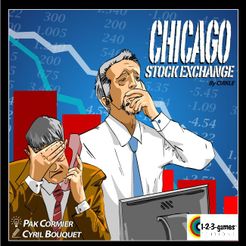
Who will be the best trader in Chicago Stock Exchange? Players trade in goods, seeking to keep the best-valued goods for themselves while ruining the values of those held by other players. To start the game, shuffle the 36 tokens — which depict six types of goods — then place them in nine stacks, with the stacks in a circle. On a turn, the active player moves a pawn 1-3 stacks, then takes the top token from the two stacks adjacent to this pawn. He keeps one token for his own holdings and sells the other, lowering the value of that good by one. (Wheat starts with a value of 7, and the other goods start at 6.) When only two stacks remain, the game ends and players tally the value of their holdings to see who best judged (and manipulated) the market. In the expert version of the game, the active player can move any number of spaces clockwise around the stacks, but must stop if he reaches a stack topped with the same type of good as that of the stack from which he started his movement.
| Edition | Year | Language | Publisher / Region |
|---|---|---|---|
| No editions imported yet. | |||
No files imported yet.
No commerce mappings imported yet.
No linked items imported yet.