Table feel
Moderate level of direct and strategic confrontation with high interaction frequency, but low emphasis on cooperation.
Players
2-4
Time
?-?
Age
8+
Weight
1.63
Rating
6.26
Teaching signal
High replayability
Highly interactive
Scales well
Deep strategy
Luck-sensitive
Moderate level of direct and strategic confrontation with high interaction frequency, but low emphasis on cooperation.
Captain Future has a high replayability score due to its high variability gameboard, impactful expansions, deep strategic possibilities, and good scalability. The game offers fresh experiences each time it is played, allowing players to discover new tactics and strategies. The presence of expansions adds new content and gameplay elements, further enhancing the replay value. The game adapts well to different player counts without compromising its appeal or balance. While it may take some time to learn, the depth it offers makes it worth the investment.
The final luck score for Captain Future is 5.67. The game has a moderate level of randomness impact, with random elements having a notable but not exclusive impact on the game outcome. There is some room for players to influence or mitigate the effects of randomness through strategic decisions, but luck still plays a significant role. The overall luck dependence is balanced, with a mix of luck and strategy determining the game outcome. While luck does play a role, player strategy and decisions also have a significant influence on the game.
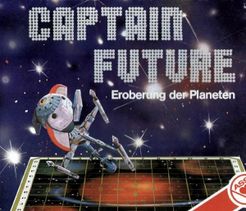
A Mysterious Universe. Silver and glass rockets jet around the galaxy. Other planets are now being populated by courageous scientists and spacemen. Captain Future with his team of the space pirate GRAG, Otto the Android, and Simon Wright, the living brain, dive into the fight against foreign invaders. Object of the game is to occupy as many spaces on the planets as possible. Bits: 1 board, 66 space cards, (space and event cards) 170 spaceships, 1 secret stone, rules. Once all spaces on a planet are occupied, the planet is conquered. Whoever has the majority on a planet can play a card to kick a foreign ship off the planet. A player without a majority, but at least a space on the planet can conquer a spaceship on the planet with two cards. A player without a spaceship on the planet can conquer with 3 cards. If no players have a definite majority, then all attacks require two or three cards. The game ends when a player plays his last ship. Each other player may play one more time before the game ends. Each player gets as many points as he has spaceships on planets. Whoever completely controls a planet gets 5 for a big planet, 4 for an average planet, and 3 for a moon. For other planets a player with a majority receives one extra point. Whoever has the most points wins the game. Origo seems to be a reworking of this game
| Edition | Year | Language | Publisher / Region |
|---|---|---|---|
| No editions imported yet. | |||
No files imported yet.
No commerce mappings imported yet.
No linked items imported yet.