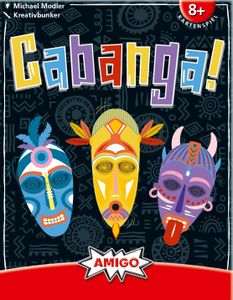
Table feel
Cabanga! has a high level of direct confrontation and strategic depth, with frequent interaction among players. However, it does not emphasize cooperation as much.
In Cabanga!, players try to get rid of their hand of cards as quickly as possible — but ideally without picking up penalties along the way. After the row cards and starting cards in all four colors have been placed in the middle of the table and players each have a hand of eight...
Players
3-6
Play time
Not listed
Age
8+
Complexity
1/5
Rating
6.79
Group fit
ABG editorial scores on a 1–5 scale.
Harder to teach
High replayability
Highly interactive
Scales well
Deep strategy
Luck-sensitive
Cabanga! has a high level of direct confrontation and strategic depth, with frequent interaction among players. However, it does not emphasize cooperation as much.
Cabanga! has a high replayability score due to its high variability gameboard, strategic depth, and scalability. The presence of expansions adds additional content and the game offers a moderate level of easiness to learn.
The final luck score for Cabanga! is 6, indicating a balanced mix of luck and strategy. The game outcome is influenced by random elements like dice rolls or card draws, but players have substantial ability to mitigate the effects of randomness through strategic decisions and planning. While luck plays a significant role, player strategy and decisions also have a notable impact on the game outcome.
In Cabanga!, players try to get rid of their hand of cards as quickly as possible — but ideally without picking up penalties along the way. After the row cards and starting cards in all four colors have been placed in the middle of the table and players each have a hand of eight...
In Cabanga!, players try to get rid of their hand of cards as quickly as possible — but ideally without picking up penalties along the way. After the row cards and starting cards in all four colors have been placed in the middle of the table and players each have a hand of eight cards, the round begins. Players then take turns placing one card next to the matching row card in the middle, ideally with as small a difference as possible because the larger the number gap, the greater the chance that the other players will call out "Cabanga!" and throw cards with the values between the two number cards to the active player. These thrown-in cards are placed on the discard pile, then the active player must draw the same number of cards from the penalty pile. When a player has no more cards in hand, the round ends and all players count the points on their cards. As soon as a player has collected 18 points, the game ends and the player with the fewest points wins!
Shopping
Compare listed prices, then confirm the edition, shipping, and availability with the retailer.
No live prices are available yet. The shopping references below may still help.
Box art, components, and videos that help you understand the game.
Language and publisher variants currently recorded in the catalog.
| Edition | Year | Language | Publisher / Region |
|---|---|---|---|
| No editions imported yet. | |||
Rulebooks, player aids, FAQs, and solo resources.
No files imported yet.
No published linked games yet.