Table feel
Brix has a high level of direct confrontation and strategic depth in confrontation. Players must frequently pay attention to and react to others' strategies and turns. However, there is less emphasis on cooperation in the game.
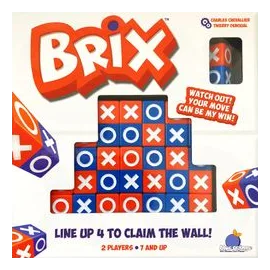
Brix brings a new dimension to tic-tac-toe, with players building a wall of X and O bricks by stacking their pieces on top of each other. The first player to align four of their symbol or color in a row wins the game. In more detail, the bricks are effectively two cubes pushed to...
Players
2
Time
?-?
Age
7+
Weight
1.33
Rating
6.05
Should this hit the table?
Brix has a high level of direct confrontation and strategic depth in confrontation. Players must frequently pay attention to and react to others' strategies and turns. However, there is less emphasis on cooperation in the game.
Teaching signal
High replayability
Highly interactive
Scales well
Deep strategy
Luck-sensitive
Brix has a high level of direct confrontation and strategic depth in confrontation. Players must frequently pay attention to and react to others' strategies and turns. However, there is less emphasis on cooperation in the game.
Brix offers a high level of variability with its gameboard and multiple paths to victory. The presence of expansions adds to the replay value. The game provides deep strategic possibilities and allows players to improve their tactics over time. The player interaction score is moderate, and the game scales well with different player counts. While it may take some time to learn, the depth it offers makes it worth the effort. Overall, Brix has a solid replayability score of 7.9.
Brix has a moderate influence of luck. Random elements have a notable but not exclusive impact on the game outcome. Players have substantial ability to mitigate randomness through strategic decisions and planning. The game outcome is primarily determined by player strategy and decisions, with luck playing a minor role.
Overview
Brix brings a new dimension to tic-tac-toe, with players building a wall of X and O bricks by stacking their pieces on top of each other. The first player to align four of their symbol or color in a row wins the game. In more detail, the bricks are effectively two cubes pushed together, with half the brick being orange and the other half blue; when an orange face shows an X, the blue face shows an O and vice versa. Each turn the active player adds one brick to the wall either vertically or horizontally, with each new brick connecting to existing bricks on at least one face and at most eight symbols in a horizontal row. If no one has won by the time that all bricks are in the wall, then on their turn players remove one brick and place it in a new location; if you knock the wall over on your turn, you lose. The winning condition can be changed depending on how challenging you want the game to be: (1) Connecting four squares of your color OR four of your symbol; (2) Connecting four squares of your color AND four of your symbol; or (3) Connecting four squares of any color AND four of any symbol.
Media
Images, galleries, and videos are grouped here so the page feels visual before every asset is fully hosted.
No media imported yet.
Editions
| Edition | Year | Language | Publisher / Region |
|---|---|---|---|
| No editions imported yet. | |||
Files and documents
No files imported yet.
Commerce mapping
No commerce mappings imported yet.
Credits
Linked items
Related games and expansions help build a connected catalog around every title.
No linked items imported yet.