Table feel
Boom: Runaway has a high level of direct confrontation and strategic depth in confrontation. Players frequently need to be aware of and react to others' strategies and turns. However, there is limited emphasis on cooperation in the game.
Players
2-5
Time
?-?
Age
7+
Weight
1.17
Rating
6.41
Teaching signal
High replayability
Highly interactive
Scales well
Deep strategy
Luck-sensitive
Boom: Runaway has a high level of direct confrontation and strategic depth in confrontation. Players frequently need to be aware of and react to others' strategies and turns. However, there is limited emphasis on cooperation in the game.
Boom: Runaway has a high replayability score due to its high variability gameboard, availability of expansions, deep strategic possibilities, and good scalability. While it may take some time to learn, the game offers a fresh and engaging experience each time it is played.
Boom: Runaway has a moderate level of luck involved in the game. Random elements like dice rolls or card draws have a notable but not exclusive impact on the game outcome. However, players have substantial ability to mitigate randomness through strategic decisions and planning. The game outcome is primarily determined by player strategy and decisions, with luck playing a minor role.
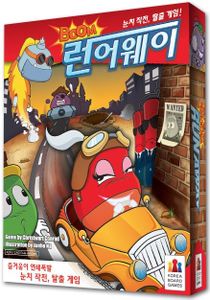
Boom: Runaway is a light bidding/bluffing/deduction card game in which the players want to help peace-loving bombs flee from an armory so that they can live out their lives in peace not blowing anyone (and themselves) to bits. If too many bombs try to leave at once, though, the armory guards could force them back to work. In game terms, each round you reveal a guard card that shows a number for each of the five colors of bombs in the game. Players have a hand of bomb cards, and they first simultaneously reveal one card, then they simultaneously reveal two cards. After this, players now compare the sum for each color of bombs played. If the sum is equal to or lower than the guard's value, then whoever played the highest block of this color earns points equal to the value of the cards played and everyone else scores one point per card of this color; if the sum surpasses the guard's total, then the player with the highest sum throws away his cards of this color, then you recheck the sum. After checking each color, you reveal a new guard, then continue play. The game ends when at least one player has played a certain number of cards from his hand, at which point the player with the most points wins.
| Edition | Year | Language | Publisher / Region |
|---|---|---|---|
| No editions imported yet. | |||
No files imported yet.
No commerce mappings imported yet.
No linked items imported yet.