Table feel
Blam! has a high level of direct confrontation and strategic depth, with frequent interaction between players. However, it does not require much cooperation.
From the Invisible City Productions website: Looking for someone to shove? Strategize in Blam! with two to four elbow-room seekers. Object: To push high-scoring pieces off the board and add them to your treasure chest. You Need: A chessboard. One stash of Icehouse Pieces for each...
Players
2-4
Time
?-?
Age
7+
Weight
2.25
Rating
6.37
Should this hit the table?
Blam! has a high level of direct confrontation and strategic depth, with frequent interaction between players. However, it does not require much cooperation.
Teaching signal
High replayability
Highly interactive
Scales well
Deep strategy
Luck-sensitive
Blam! has a high level of direct confrontation and strategic depth, with frequent interaction between players. However, it does not require much cooperation.
Blam! has a high variability gameboard, offering different experiences each time it is played. The presence of expansions adds new content and gameplay elements, enhancing the replay value. The game also provides deep strategic possibilities and allows players to improve their strategy over time. The player interaction score is moderate, and the game scales well with different numbers of players. While it may take some time to learn, the depth it offers makes it worth the effort. Overall, Blam! has a strong replayability score of 8.09.
Blam! has a moderate influence of luck. Random elements like dice rolls and card draws have a notable but not exclusive impact on the game outcome. Players have some ability to mitigate randomness through strategic decisions and planning. The game outcome is a balanced mix of luck and strategy.
Overview
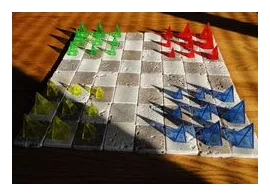
From the Invisible City Productions website: Looking for someone to shove? Strategize in Blam! with two to four elbow-room seekers. Object: To push high-scoring pieces off the board and add them to your treasure chest. You Need: A chessboard. One stash of Icehouse Pieces for each player. No stash may have the same color as another stash. On your turn, place a piece from your stash in a vacant space on the board. If there are any pieces in adjacent spaces (including diagonals), move them one space directly away from the piece you placed. You’ve just slammed a major impact onto the board, and it scattered nearby pieces. If a moving piece attempts to enter an occupied space, allow it to, and push the occupying piece into the space beyond; this may cause entire rows of pieces to move. If a piece attempts to leave the board, place it in your treasure chest — unless it’s your color. If it’s your color, put it in your stash. Once all pieces have been relocated, your turn ends. Play passes to the left. The game ends when all stashes are empty or when all players agree to stop playing. Winning: Each piece has a point value equal to the number of pips on it (1, 2, or 3). Tally the points in your treasure chest and your stash. If your score is the highest, you win.
Media
Images, galleries, and videos are grouped here so the page feels visual before every asset is fully hosted.
No media imported yet.
Editions
| Edition | Year | Language | Publisher / Region |
|---|---|---|---|
| No editions imported yet. | |||
Files and documents
No files imported yet.
Commerce mapping
No commerce mappings imported yet.
Credits
Linked items
Related games and expansions help build a connected catalog around every title.
No linked items imported yet.