Table feel
Moderate interaction
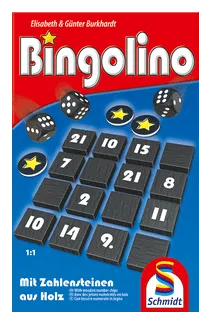
Each player in Bingolino starts by taking sixteen tiles from the pool of 66. These tiles are numbered 1-22, with each number appearing three times, and each player arranges these tiles in a 4x4 grid with the tiles face up in whatever order they wish. On a turn, the player rolls 1...
Players
2-4
Time
?-?
Age
8+
Weight
1.33
Rating
5.99
Should this hit the table?
Moderate interaction
Teaching signal
High replayability
Low interaction
Scales well
Deep strategy
Luck-sensitive
Moderate interaction
Bingolino offers a high level of variability with its gameboard, allowing for different experiences each time it is played. The expansions available add new content and gameplay elements, enhancing the replay value. The game offers deep strategic possibilities and room for improvement in tactics and strategies. The player interaction score is average. Bingolino scales well with different numbers of players without compromising its appeal or balance. While it may not be the easiest game to learn, it offers a good balance between easiness and depth. Overall, Bingolino has a strong replayability score of 8.02 out of 10.
Bingolino has a low influence of luck. The game outcome is predominantly determined by random elements like dice rolls or card draws, with very little room for players to influence or mitigate the effects of randomness. However, players have substantial ability to mitigate randomness through strategic decisions and planning. Overall, the game is heavily dependent on luck, with little influence from player strategy.
Overview
Each player in Bingolino starts by taking sixteen tiles from the pool of 66. These tiles are numbered 1-22, with each number appearing three times, and each player arranges these tiles in a 4x4 grid with the tiles face up in whatever order they wish. On a turn, the player rolls 1-5 six-sided dice, then announces the number rolled. Each player can flip one tile in their grid matching this number face down; if the active player didn't flip a tile, they can choose to remove one of the dice to lower the total, then flip a tile with this number face down. If the active player still can't flip a tile face down, then they must flip one of their already face-down tiles face up. When a player creates a row of face-down tiles, whether orthogonally or diagonally, they take a star token and place it at the end of this row. (If they have to flip a tile in this row face up, they don't lose the star, but neither would they gain another star for flipping this tile face down again.) The first player to claim four stars wins!

Media
Images, galleries, and videos are grouped here so the page feels visual before every asset is fully hosted.
No media imported yet.
Editions
| Edition | Year | Language | Publisher / Region |
|---|---|---|---|
| No editions imported yet. | |||
Files and documents
No files imported yet.
Commerce mapping
No commerce mappings imported yet.
Credits
Linked items
Related games and expansions help build a connected catalog around every title.
No linked items imported yet.