Overview
At a glance
Is this game right for my group?
ABG editorial scores on a 1–5 scale.
Harder to teach
High replayability
Highly interactive
Scales well
Deep strategy
How it plays
How does it play?
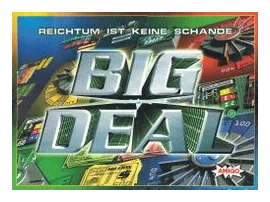
Big Deal is a game of corporate business deals. Players are big investors (and I mean big - the smallest notes are $50 million and billions of dollars change hands) and wheeler-dealers.
Core mechanisms
Key systems that shape the decisions players make.
Read the full game description
Big Deal is a game of corporate business deals. Players are big investors (and I mean big - the smallest notes are $50 million and billions of dollars change hands) and wheeler-dealers. Players acquire shares in companies, primarily randomly (picked up as cards), but also possibly through purchase of other players' previous sales. To form the companies they must also acquire resources, which are bought from 4 sets. The pricing mechanism for these is like Palmyra and McMulti - each purchase increases the price and each sale decreases it. Once an appropriate set is acquired for a matching set of (at least two) shares in a company, the company can be formed. Companies pay income to their owners each turn. They can also be sold off at a premium, or split up (provided the owner has enough shares and resources) to gain double income. The real heart of the game comes in the option to conduct hostile takeovers. A player lays one or more shares in a company owned by another player and then starts a bidding war to takeover the company. Each player is bidding to buy the shares of the opponent (bids are per share). The "winner" gets the company and all the shares, the "loser" is paid off at the final bid price. Who is actually the winner and loser depends, of course, on the balance of the final price. There is a sudden death variable finish, when assets plummet in value, so there is a tense few final rounds when players can try to realize assets while they are still valuable. During this period the judgment of takeover prices becomes even more tricky (and a gamble).