Overview
At a glance
Is this game right for my group?
ABG editorial scores on a 1–5 scale.
Harder to teach
High replayability
Highly interactive
Scales well
Deep strategy
How it plays
How does it play?
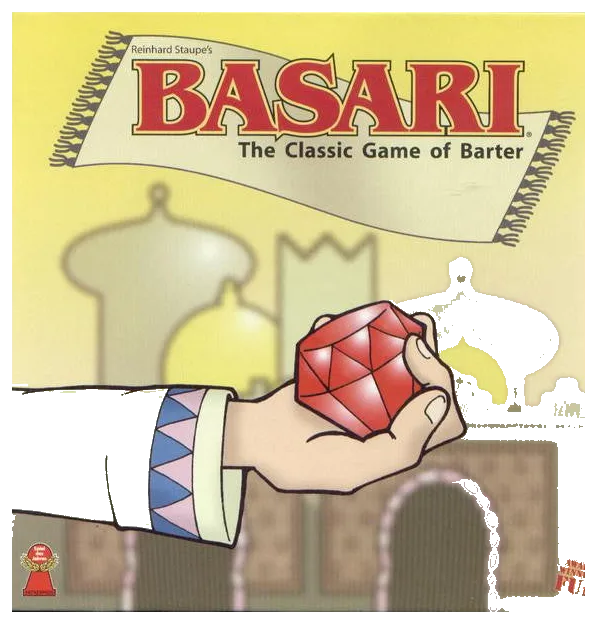
Basari is a game of gem merchants competing in a marketplace": racing, collecting, trading, and predicting what the other merchants will do. To start the game, players receive 12 gemstones (3 each of 4 colors).
Core mechanisms
Key systems that shape the decisions players make.
Read the full game description
Basari is a game of gem merchants competing in a marketplace": racing, collecting, trading, and predicting what the other merchants will do. To start the game, players receive 12 gemstones (3 each of 4 colors). Each turn there will be a movement phase and an action phase: For movement, everyone simultaneously rolls their die and moves their markers around a track. They then choose one of three different actions to perform. The actions are: - to take a variety of gems from a market stall, - to immediately score from between 4 and 7 points, or - to roll and move again and also collect points. The action cards are revealed simultaneously. If only 1 player chose a particular action, they simply perform that action. If 2 players chose the same action, they barter back and forth with gemstones. One player will eventually accept the other's offer of gems, and the other will take the action. If 3 or 4 players all chose the same action card, that action is cancelled. Note that in 4-player games, there will always be a conflict in choice of 3 actions, so much more negotiating goes on. A new turn begins with everyone rolling their die, moving, then choosing and revealing their action cards. When any merchant piece completes a lap around the board, the round ends and bonus points are awarded based on who has the majority in each gem color and who has completed a lap. After three rounds, the game is over and the highest score wins. Re-implemented by: Edel, Stein & Reich