Table feel
Apagos has a high level of direct confrontation and strategic depth in confrontation. Players need to be aware of and react to each other's strategies frequently. However, there is less emphasis on cooperation in the game.
Players
2
Time
?-?
Age
7+
Weight
1
Rating
6.47
Teaching signal
High replayability
Highly interactive
Scales well
Deep strategy
More strategic control
Apagos has a high level of direct confrontation and strategic depth in confrontation. Players need to be aware of and react to each other's strategies frequently. However, there is less emphasis on cooperation in the game.
Apagos has a high variability gameboard, good expansions available, deep strategic possibilities, moderate player interaction, good scalability, and moderate easiness to learn. Overall, it offers a solid replayability experience.
Apagos has a moderate level of randomness impact, where random elements have a notable but not exclusive impact on the game outcome. However, players have substantial ability to mitigate randomness through strategic decisions and planning. The game outcome is primarily determined by player strategy and decisions, with luck playing a minor role.
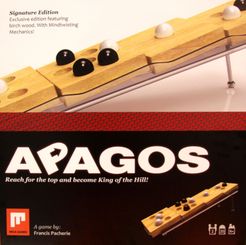
In this two-player game, players line up four turtles in a row and lay out ten black and ten white balls. The turtles are two-sided and have a different number of holes on each side, although always an odd number. On a turn, a player either takes a ball of any color, places it on an empty hole on a turtle, and moves that turtle one space forward in line (assuming it's not at the front) or moves one of his balls already on a turtle backward to a different turtle, leaving all turtles in the same locations. The game ends when all the holes are filled, and the winner is the player who has the most balls on the turtle at the head of the line.
| Edition | Year | Language | Publisher / Region |
|---|---|---|---|
| No editions imported yet. | |||
No files imported yet.
No commerce mappings imported yet.
No linked items imported yet.