Overview
At a glance
Is this game right for my group?
ABG editorial scores on a 1–5 scale.
Harder to teach
High replayability
Highly interactive
Scales well
Deep strategy
More strategic control
How it plays
How does it play?
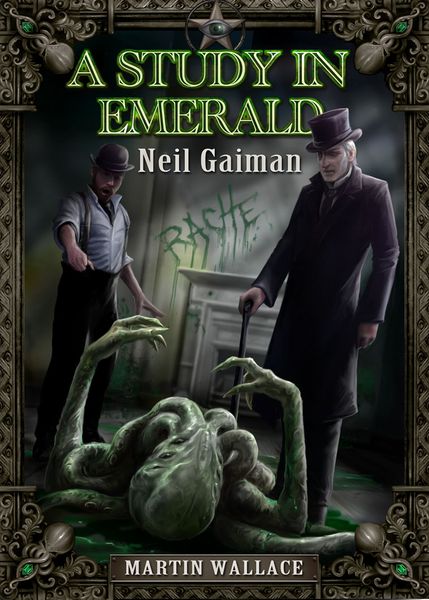
Build a deck, contest cities, deploy agents, and conceal your allegiance in Martin Wallace’s first-edition Sherlock Holmes–Lovecraft secret war.
Core mechanisms
Key systems that shape the decisions players make.
Deck / Bag Building
Add new pieces during play to improve the cards, tokens, or dice drawn later.
Hidden Roles
Players conceal team, loyalty, or identity information from one another.
Area Majority
Compete to have the strongest presence in areas that award control or points.
Hand Management
Time and sequence a limited hand of cards to preserve future options.
Open Drafting
Select cards or items from a shared face-up display.
Point-to-Point Movement
Move along explicit connections between named locations or nodes.
Read the full game description
A Study in Emerald is Martin Wallace’s ambitious 2013 design based on Neil Gaiman’s story, mixing Sherlock Holmes, Victorian anarchists, and Lovecraftian rule. Players begin with secret Loyalist or Restorationist identities and use influence cubes to compete for cards and control of cities. Drafted cards expand a personal deck with agents, assassinations, movement, protection, and one-use events; agents then operate across a point-to-point map while war and revolution tracks push the world toward several possible endings. The central tension is collective as well as personal: the weakest member of a faction can condemn everyone on that side, yet revealing your allegiance too early invites sabotage. This is the expansive first edition, not the later streamlined second edition, and its volatile systems create a singular negotiation-and-deduction game.