Overview
At a glance
Is this game right for my group?
ABG editorial scores on a 1–5 scale.
Harder to teach
High replayability
Highly interactive
Scales well
Deep strategy
More strategic control
How it plays
How does it play?
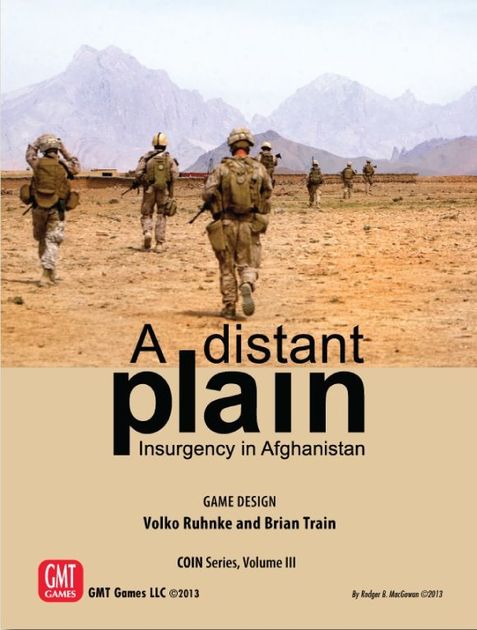
Navigate the tangled insurgency in Afghanistan as the Coalition, Afghan Government, Taliban, or Warlords in a deeply asymmetric COIN struggle.
Core mechanisms
Key systems that shape the decisions players make.
Area Majority
Compete to have the strongest presence in areas that award control or points.
Area Movement
Move pieces between connected regions rather than along individual spaces.
Variable Player Powers
Each player has different abilities, restrictions, or strategic advantages.
Dice Rolling
Roll dice to introduce uncertainty into actions, production, movement, or resolution.
Variable Phase Order
The order of phases changes according to player choices or game state.
Solo / Solitaire Game
Provide rules and objectives designed for a single player.
Read the full game description
A Distant Plain is a four-faction strategy game about the insurgency in Afghanistan after 2001. Each faction pursues a different victory condition: the Coalition seeks popular support while reducing deployed forces, the Afghan Government builds control and patronage, the Taliban spreads opposition and bases, and the Warlords profit from ungoverned territory. A shared deck drives play through events and paired operations. Choosing an operation often makes a faction ineligible for the next card, so timing is as important as tactical effect. Operations move troops, train local forces, rally guerrillas, sweep provinces, assault enemies, or exploit resources; faction-specific special activities make similar actions behave very differently. Roads, cities, population, support, control, casualties, aid, and patronage form an interlocking political and military system. Coalitions are useful but temporary because only one faction can win. The included non-player flowcharts allow one player to contest all four sides, while short and full scenarios scale the campaign’s commitment. Every move asks whether immediate security is worth strengthening a rival’s long-term position.